Chapter 2: The Regenerative City Framework
Composed of outcomes, strategies and enablers, the Regenerative City Framework presented in this chapter acts as a springboard that each city can adapt from and build upon.
Last updated on 13 June 2026
Developing the Regenerative Approach for Cities
Around the world, we have witnessed notable instances of low‑carbon development, but a large-scale transition has not been completed anywhere to date.
How can the regenerative approach be made useful for leaders and practitioners seeking city-wide application?
Over 100 academics, urban practitioners and policymakers across disciplines and geographies were convened to answer this question. These engagements revealed several obstacles including clear absence of shared metrics for measuring regenerative outcomes, knowledge gaps on effective regenerative strategies, and need for better guidance to create an enabling environment for regenerative approaches.
The CLC, with research support from the Singapore University of Technology and Design, developed the Regenerative City Framework, through methodological deep dives. A shared foundation emerged: a consensus-based definition of regenerative cities, a set of guiding principles and a validated compendium of strategies, enablers and outcomes.
.jpg)


Definition of a Regenerative City
A regenerative city goes beyond sustainability—which strives to reduce harm—to optimise co-benefits across liveability, resilience and resource optimisation outcomes.
It is a complex and dynamic urban–natural environment where human, ecological and technological systems co-evolve to generate multiple co-benefits. In a climate-changed and resource-constrained world, a regenerative city renews and adapts to turn interdependencies into opportunities.
This definition presents the built environment as an engine for good, recognising the city as a place where both the built and natural environments can be integrated for the long-term well-being of its inhabitants. It acknowledges that cities need to redevelop and adapt to changing conditions, and that doing so in a regenerative manner can achieve positive outcomes across social, environmental and economic dimensions.
Recognising the contextual differences across the world, the definition holds space for interpretation and adaptation. It offers a common understanding of what regenerative cities are and how they function, so that every city can develop its own context-specific path.
The Regenerative City Framework
With the foundation of a shared definition, the Regenerative City Framework offers a structure that city leaders can adapt and build upon. The Framework has three components:
Outcomes that form the “north star” for what regenerative cities hope to achieve
Strategies that leaders and practitioners can act on to pursue those outcomes
Enablers that create supportive conditions for achieving those outcomes
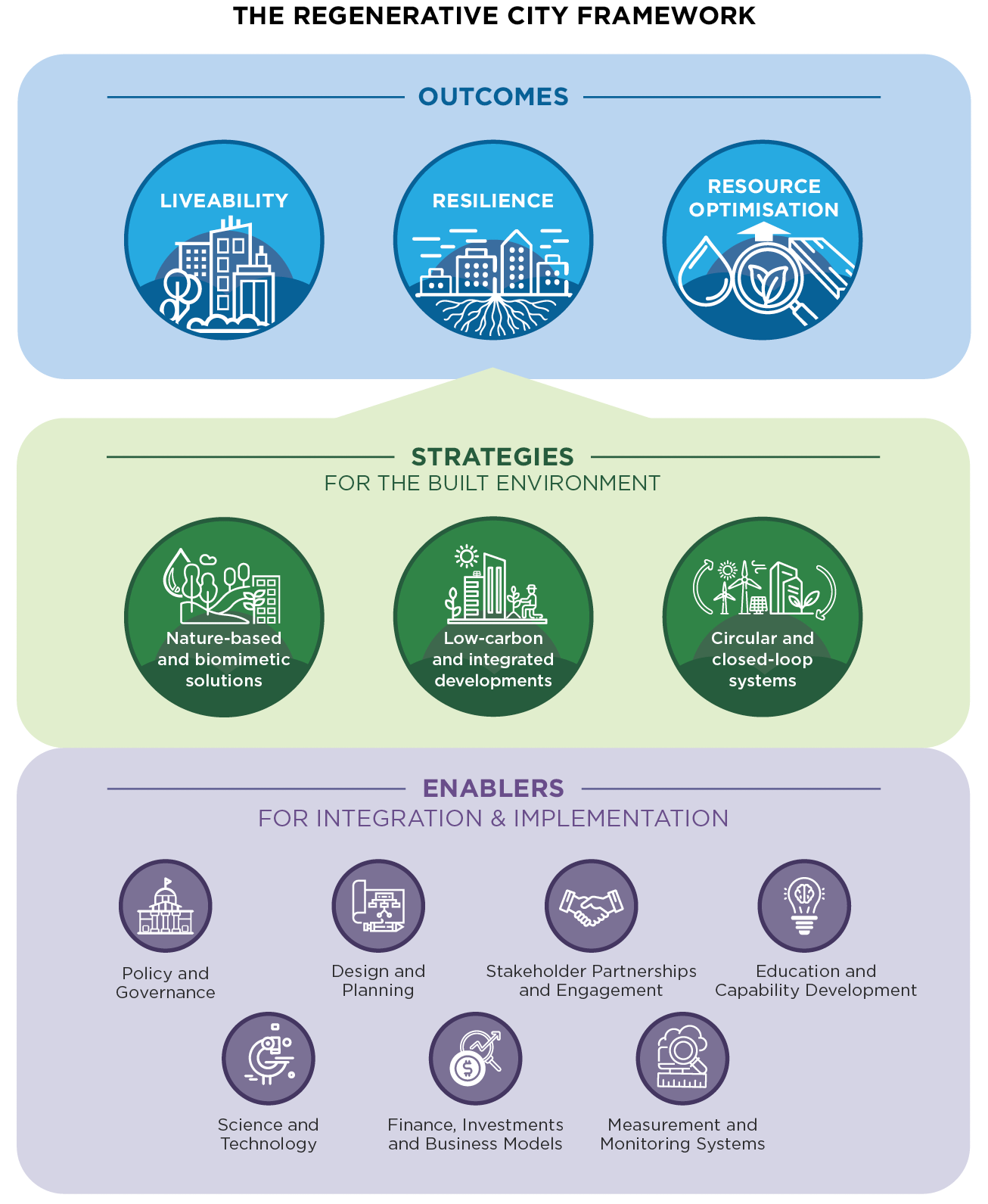
The Regenerative City Framework. (Centre for Liveable Cities)
Explore Outcomes, Strategies and Enablers
Outcomes
The Regenerative City Framework identifies three interdependent outcomes: liveability, resilience and resource optimisation.
Strategies
With the aim to set out broader directions for place-specific actions, the Framework introduces three key strategies.
Enablers
There are seven enablers in the Framework. These are the supportive conditions, resources and capacities that enable regenerative urban developments to take root.
The Regenerative City Principles
Underpinning the definition and Framework for the regenerative city are eight key principles. They ground regenerative urban development and differentiate it from more conventional approaches. All principles are aimed at helping cities translate regenerative urbanism into actionable priorities.
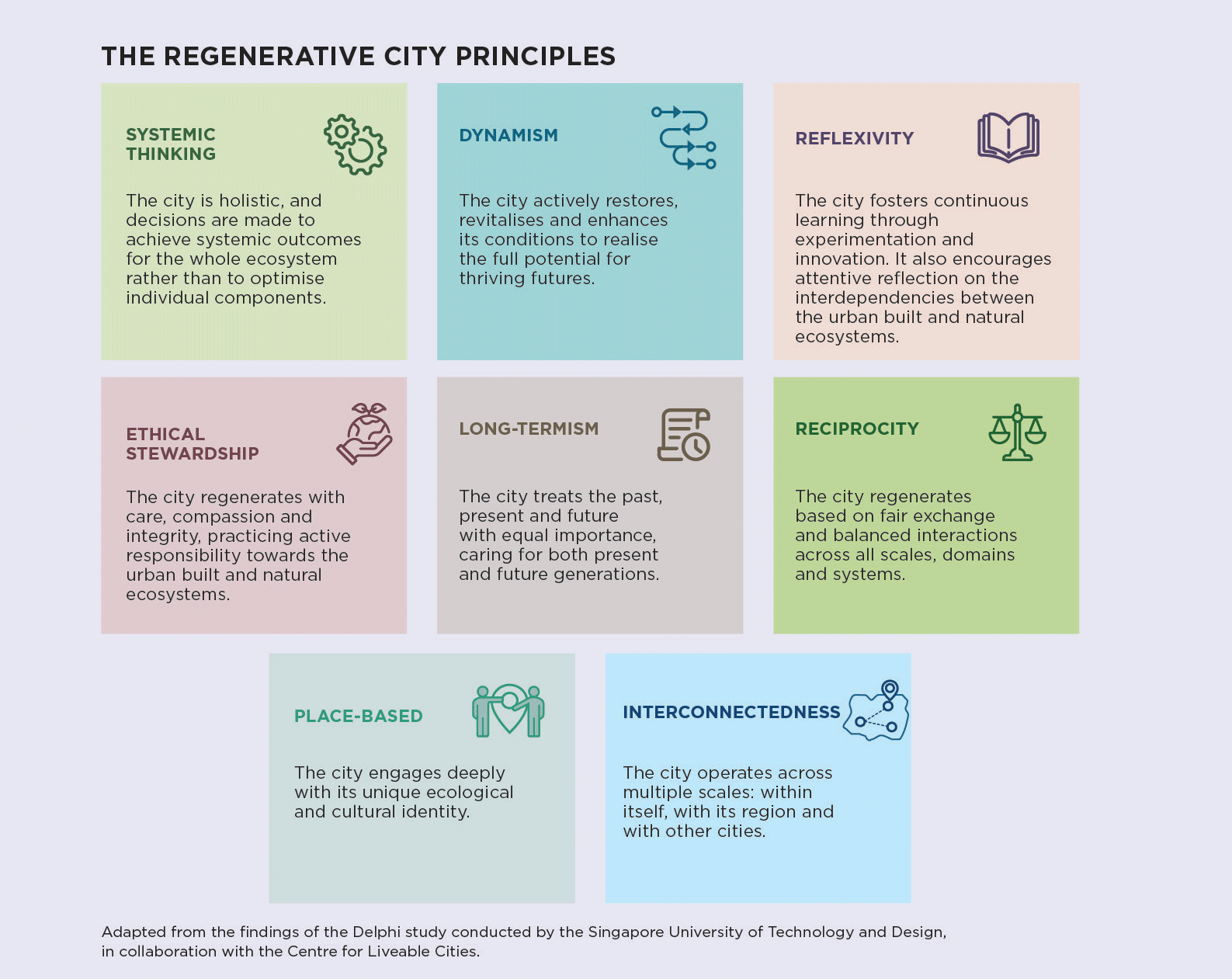
Principles of the Regenerative City. (Centre for Liveable Cities)
The Regenerative City Framework is a roadmap to show how cities can approach urban development in a way that balances the demands of urban growth against the need to secure healthy ecosystems. It invites cities to develop place-specific solutions by helping them ask better questions: which outcomes matter most, which strategies are most viable, and which enablers need to be strengthened.
Download Chapter 2 PDF [PDF, 2.23 MB] (opens in new tab)
Download Full Publication PDF [PDF, 29.60 MB] (opens in new tab)