Chapter 4: Working Towards Regenerative Cities
As cities continue to make progress in regenerative urban development, this chapter shares how scaling action involves building a collaborative ecosystem and sharpening assessment capabilities.
Last updated on 12 June 2026
Scaling Regenerative Cities
The cross-system, multi-faceted and place-based nature of the regenerative city requires a deeper understanding of the city to strengthen and scale its implementation through the following avenues.
Building a Regenerative City through a Collaborative Ecosystem of Stakeholders
The key to successful implementation of regenerative urban development is having a strong collaborative ecosystem of stakeholders across sectors. The public sector plays a crucial role in long-term planning and creating frameworks that catalyse collaboration and experimentation, while the private sector pilots new technologies, designs and financing mechanisms that enable scalable approaches. Research and academic institutions ensure innovations are evidence-based, local communities contribute ground-up insights that mobilise city-wide implementation, and international organisations facilitate knowledge exchange and access to best practices. Together, these sectors form an interconnected collaborative ecosystem that accelerates the adoption and scaling up of regenerative urban development.
Sharpening the Assessment Capabilities of the Regenerative City
The examples of assessment indicators introduced in this book articulate what to measure. Three areas for further development will sharpen assessment capabilities for scaling up.
Advance our knowledge of correlational and/or causational relationships between regenerative strategies and their respective cobenefits can improve the precision of regenerative action and enable calibration for greater impact.
Deepen our understanding of the relationship between regenerative outcomes and capacities, and assessment of the socio-ecological processes that connect them. For instance, conducting financial valuation of the ecosystem services provided by nature-based solutions that go beyond conventional economic metrics to include environmental, social and governance outcomes will more holistically capture the associated cost and benefits.
Enhance the validation and tracking of regenerative outcome and capacity indicators across timescales and district typologies. For a brownfield redevelopment project, measuring the existing site using outcome indicators provides a baseline to track the effectiveness of implementation, while tracking outcomes and capacities post-implementation over time assesses the effectiveness of interventions across the development lifecycle. Once validated, the indicators can be applied to guide greenfield development projects.
These areas of enquiry will be developed as the CLC works towards building up the Regenerative City Self-Assessment Tool (RCSAT).
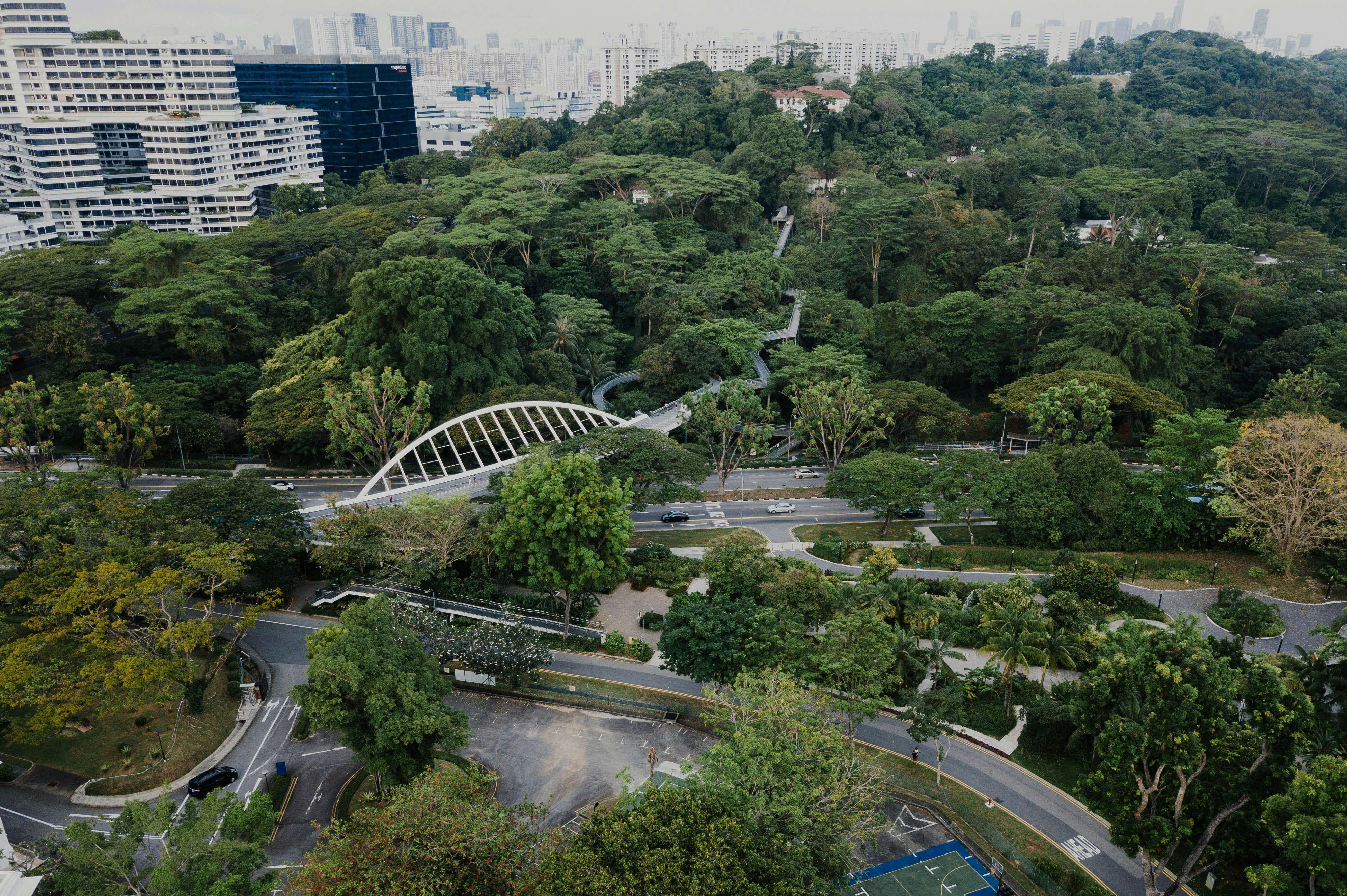
Secondary rainforests, like the Southern Ridges in Singapore, are regenerated forest patches that can help cities adapt to intensifying heats stress and flooding. (Chuttersnap / Unsplash)
A Collective Commitment
In early 2027, the Intergovernmental Panel on Climate Change (IPCC) will release its Special Report on Climate Change and Cities. This is the first IPCC report to spotlight cities both as sources of climate risks and engines of climate solutions and innovation.
Against this backdrop, regenerative urban development offers a pathway for cities to not only respond, but to lead the way in climate action. The Regenerative City Framework allows for different cities to tailor their solutions to the scale, complexity and conditions of their own contexts.
To be clear, embracing regenerative urban development does not require cities to dismantle existing sustainability efforts, nor does it eliminate all trade-offs inherent in planning and development choices.
Instead, it guides cities to build on existing initiatives, integrating more closely across urban systems to maximise co-benefits across liveability, resilience and resource outcomes. By tightening connections across communities, infrastructure and nature, regenerative approaches can amplify the impact of existing strategies.
This moment requires collective commitment and action. Platforms such as the United Nations Framework Convention on Climate Change's Conference of the Parties (COP), World Cities Summit and the City Network for the Lee Kuan Yew World City Prize (LKYWCP Network) provide avenues for cities to learn from one another, validate what works, and build the momentum to make regenerative approaches commonplace. Even in a climate-changed and resource-constrained world, we can build a liveable, resilient and regenerative future for our cities together.
Download Chapter 4 PDF [PDF, 333.51 KB] (opens in new tab)
Download Full Publication PDF [PDF, 29.60 MB] (opens in new tab)