Beyond Sustainability: Building a Regenerative Future for Our Cities
In a climate-changed and resource-constrained future, the regenerative approach offers cities a pathway to move beyond reducing harm to doing more good for the entire urban ecosystem.
Last updated on 13 June 2026
Overview
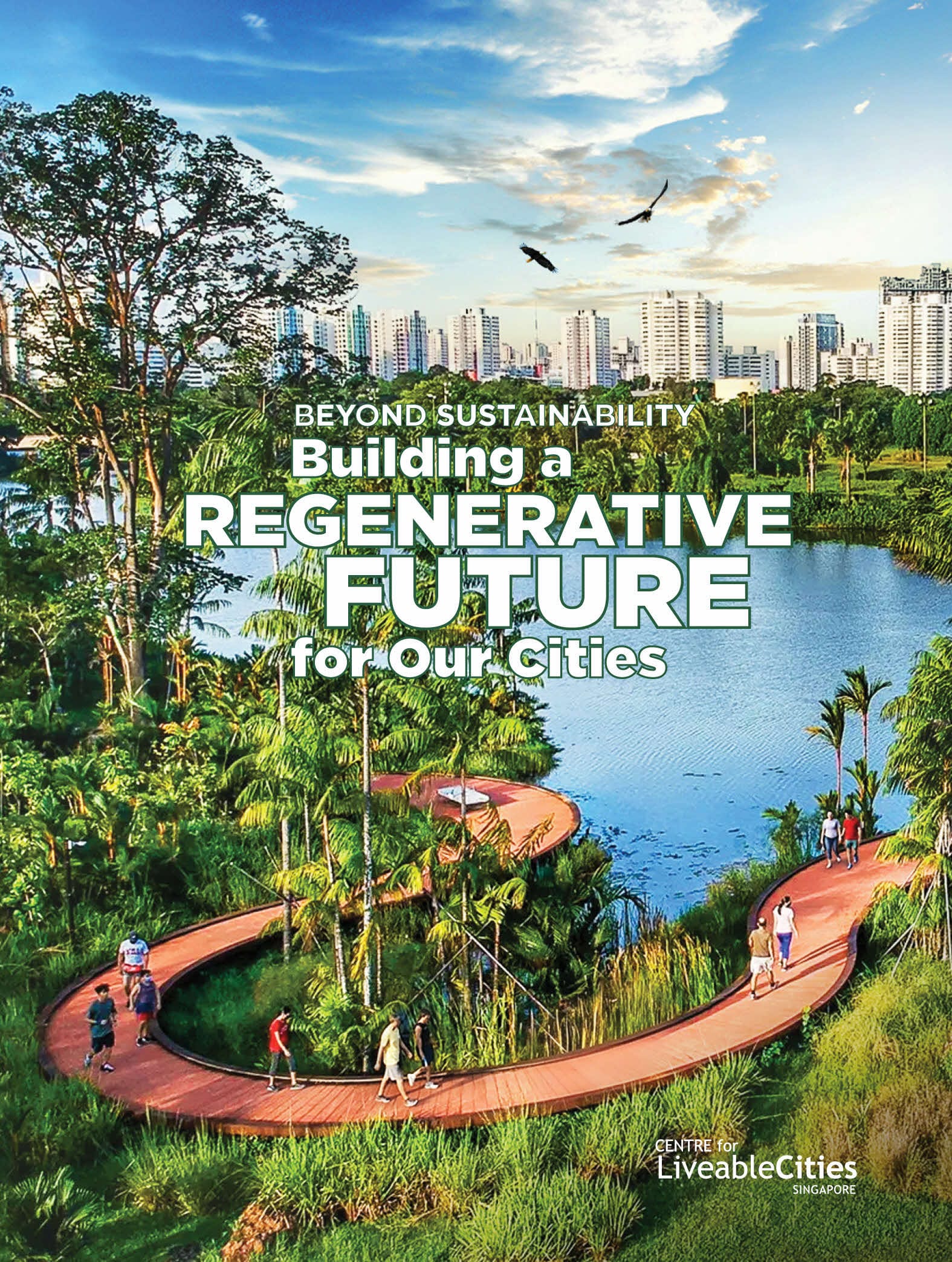
Cover of Beyond Sustainability: Building a Regenerative Future for Our Cities (Centre for Liveable Cities)
Beyond Sustainability: Building a Regenerative Future for Our Cities frames a central question: How can cities remain liveable and resilient in a climate-changed and resource-constrained world?
Drawn from the Centre for Liveable Cities' research and multisectoral engagements with over 100 experts across the globe, this publication captures insights, ideas and case studies to propose a way ahead for cities that is grounded in regenerative design principles. At the core of this publication lies a recurring takeaway that the regenerative city requires a co-benefits view to urban development, that integrates mitigation and adaptation action to maximise impact. Cities are actors that must lead the way in climate action, and we posit that regenerative urban development is a potential next course of action.
This publication is produced with research support from the Singapore University of Technology and Design.
Download Full Publication PDF [PDF, 29.60 MB] (opens in new tab)
Foreword by Minister for National Development, Mr CHEE Hong Tat
Climate change is an existential challenge for cities worldwide. Beyond Sustainability: Building a Regenerative Future for Our Cities presents the Regenerative City as a pathway forward, through an urban development model that expands the boundaries of sustainable urban development. A city may be sustainable but not regenerative; but a regenerative city would certainly be more sustainable and resilient than one that is not.
Drawing from best practice examples in Singapore and cities around the world, this publication distils practical strategies, key enablers and assessment indicators to support cities to put regenerative urban development into action. This requires close integration across different urban systems, for cities to maximise the benefits for its residents across liveability, resilience and resource efficiency.
In Singapore, we will be embarking on an ambitious long-term reclamation project to develop “Long Island” along our Eastern coast. This project will achieve three goals—provide coastal protection against sea level rise, enhance our water resilience, and create new land for future development such as housing and recreation. It is an example of our long-term, integrated planning approach to judiciously balance different land use requirements, navigate difficult trade-offs, and maximise every parcel of land as we develop our city-state.
To meet our climate goals, we rolled out the latest edition of the Singapore Green Building Masterplan (SGBMP) together with the industry in 2021. The SGBMP captures our collective commitment to pursue more ambitious sustainability standards in our built environment. A key initiative is the Green Mark certification scheme which encourages higher standards of environmental sustainability for developments in the tropical climate.
The latest version of the Green Mark scheme (GM: 2021) aims to raise our standards in building energy performance and place greater emphasis on other sustainability outcomes such as designing for maintainability, reducing embodied carbon across a building's life cycle and creating healthier environments for building users. There are now over 2,600 Green Mark-certified buildings in Singapore. Over the past 20 years since the inception of the Green Mark scheme, these buildings collectively save over 4.2 billion kilowatt-hours of energy annually and generate S$1.3 billion in cost savings each year.
As we transform Singapore into a City in Nature, we will continue to leverage nature-based solutions for climate adaptation and to enhance liveability for residents. We will add more than 25 new parks and 50 kilometres of park connectors by 2030. We are strengthening ecological connectivity through Nature Ways, which mimic the multi-tiered structure of forests, to cool streets and support native biodiversity. We will also restore mangroves along Singapore's coastlines to safeguard our coastal areas from storm surges and rising sea levels.
By addressing both the built and natural environments as key elements of our urban development, these efforts reflect a regenerative approach, which helps Singapore to achieve better sustainability and resilience outcomes over the longer term.
I hope that this publication will be a useful reference and a source of inspiration for city leaders and practitioners. By working together to share knowledge and develop capabilities, we can strengthen the collective efforts to build regenerative cities for our current and future generations.
Foreword by Minister for Sustainability and the Environment, Ms Grace FU
We are living in a climate-impaired and resource-constrained world. Cities are not only emission hotspots, but are also vulnerable to climate risks, while at the same time facing mounting resource constraints and waste management challenges. Despite these, cities are uniquely positioned to develop innovative solutions to address these challenges.
Singapore will not be spared from the impacts of climate change. Our Third National Climate Change Study projected that, by 2100, Singapore could experience increases in annual mean temperatures of up to 5°C, mean sea levels of up to 1.15 m, and extreme weather events.
We have started making preparations to adapt to these impacts, in areas such as heat, coastal and flood resilience, and water and food resilience. Singapore is developing our first National Adaptation Plan, which will serve as our long-term, living strategy to continue thriving in the face of climate change. We have designated 2026 as the Year of Climate Adaptation to raise awareness on the importance of adaptation, galvanise collective action, and co-create solutions with key public, private and people stakeholders.
Even as we adapt, we must also continue to stay the course on climate action—contributing to global mitigation efforts while securing Singapore's long-term competitiveness and energy resilience. Singapore has committed to achieve net zero emissions by 2050, and submitted our 2035 Nationally Determined Contribution (NDC) to reduce our emissions to between 45 and 50 million tonnes of carbon dioxide equivalent (tCO2e). We have pressed on with decarbonisation efforts, including raising our carbon tax in 2026 and 2027 to S$45/tCO2e, and expanding solar deployment.
Our Singapore Green Plan (SGP) 2030 is a whole-of-nation movement to rally collective action to build a liveable, resilient city while achieving our long-term net zero emissions goal. As part of the SGP, Singapore is shifting towards a circular economy to reduce emissions, maximise resource efficiency and resilience, and conserve scarce landfill space. Launched in 2019, our Zero Waste Masterplan targets a 30% reduction in waste sent to landfill per capita each day by 2030. We have had successes with certain waste streams, such as metals and construction and demolition materials, with near 100% recycling rates. Along with our other National Taps, we have also created a sustainable, circular system through NEWater, which allows us to reuse every drop of water and strengthen our water resilience. Through integrated planning and design, technology, regulations, and cultivating a green citizenry, we are creating synergies across the water, energy, food and waste sectors, so that precious resources can be kept within closed-loop systems.
Beyond Sustainability: Building a Regenerative Future for Our Cities introduces the Regenerative City model, which supports cities in implementing climate adaptation and mitigation actions in ways that optimise resource use and strengthen liveability and resilience. Featuring ideas and case studies from Singapore and cities worldwide, the publication challenges practitioners to think about how cities might consider the entire urban ecosystem, and design closed-loop systems suited to their own unique circumstances.
I hope that this publication will provide valuable insights as we strengthen our collective efforts to build climate-ready and resource-resilient cities.
Chapter 1: The Regenerative Approach as the Next Bound for Urban Development
Amid intensifying climate impacts and resource constraints, cities are looking beyond the sustainability approach of minimising harm to adopt regenerative design. This chapter outlines four key paradigm shifts—from "doing less bad" to "doing more good", from navigating trade-offs to optimising co-benefits, from human-centric systems to urban ecosystems, and from end-of-life to closed-loop planning—that are defining the regenerative approach.
Chapter 2: The Regenerative City Framework
Bridging the regenerative approach with real-world operating capacities, this chapter introduces the Regenerative City Framework. It features three core components: outcomes that define the goals of the regenerative city; strategies for pursuing the desired outcomes; and, enablers that create supportive conditions for achieving the outcomes. Its foundations of a shared definition, principles and implementation pathways are key to enabling city leaders to operationalise regenerative urban development.
Chapter 3: Measuring the Regenerative City
Building on the Regenerative City Framework, this chapter addresses how cities are assessed using two sets of assessment indicators: regenerative outcomes track implementation progress, and regenerative capacities evaluate existing conditions and ability to harness co-benefits. Together, they reveal how capacity investments impact outcomes across the development lifecycle. The Regenerative City Self-Assessment Tool (RCSAT) is also introduced to support this process.
Chapter 4: Working Towards Regenerative Cities
To scale regenerative urban development and unlock exponential impact, cities need to strengthen global collaboration efforts and assessment capabilities. This chapter proposes the next steps for cities to strengthen and scale implementation.
Publication Annexes, Op-eds and Other Resources
This section gathers additional resources and essays written by experts, providing more information on the Regenerative City Framework and Self-Assessment Tool and insight into the different facets of regenerative urban development.
SarahBastin-C40_8565.jpg)
.jpg)
.jpg)