
Publication Op-eds
Urban Environmental Modelling for Sustainable Town Design
14 June 2026
By Tan Sze Tiong Chief Sustainability Officer and Group Director of the Building and Research Institute, Housing and Development Board, Singapore
The Integrated Environment Modeller was developed to improve town planning methodologies by providing data-driven insights for environmental optimisation.— Tan Sze Tiong

The Housing and Development Board (HDB) has long integrated climate-sensitive design in Singapore's public housing projects. In recent years, the HDB has intensified efforts to mitigate climate change effects and create more comfortable environments for residents through various strategies and initiatives.
In 2018, the HDB partnered with the Agency for Science, Technology and Research (A*STAR) to jointly develop the Integrated Environmental Modeller (IEM). The IEM is an advanced modelling tool which uses high-resolution 3D city models that enable our planners, architects and engineers to simulate the interaction of environmental factors such as solar irradiance, wind flow, air temperature and noise levels, as well as their combined effects, on our urban setting.
The IEM was developed to improve town planning methodologies by providing data-driven insights for environmental optimisation. The primary objective is to support informed decisions that will enhance thermal comfort, reduce urban heat island effects, and create more liveable public housing environments through passive cooling strategies.
With the IEM, we can simulate how the placement and configuration of HDB blocks would affect wind flow, and where amenities such as playgrounds and childcare centres should be located so they are comfortable for their users. Similarly, we can identify potential hotspots and implement mitigation measures, such as the planting of greenery or application of cooling materials, to reduce the build-up of heat, even before construction starts.
The HDB's first eco-town, Punggol, offers an ideal testing ground for implementing innovative sustainable housing solutions. At the same time, its waterfront location and undeveloped land provide opportunities to incorporate comprehensive environmental planning from the ground up. Punggol was therefore selected as a test case to validate the results generated by the IEM.
Simulation results were compared with comprehensive data collected over a two-month period from sensors strategically positioned across different locations within the town to represent various urban microclimates. The data included wind speed and direction, ambient temperature, solar irradiation levels, relative humidity, mean radiant temperature and surface temperature. The comparison demonstrated that the IEM accurately simulated the diurnal behaviour of these environmental factors and predicted both daily temperature cycles and wind patterns, confirming the model's reliability for future applications.
At the precinct level, the IEM enables identification of hotspots for implementation of mitigation measures to reduce heat build-up and channel wind flow. In Punggol Northshore, this method has enabled planners to set aside shaded green spaces for outdoor activities. One example is the Community Wave feature found in Northshore Residences, where children of all ages can play in a shaded and breezy area near the childcare centre.
Following this, the IEM was adopted in the planning and urban design of Tengah, including mapping of town-wide wind flow and solar heat gain. The IEM was adopted to design several Build-To-Order projects in Tengah, such as Parc Residences @ Tengah and Parc Clover @ Tengah. Their precinct amenities, such as a rooftop sky community park featuring playgrounds, fitness corners and a brisk-walking track, will be located in areas largely shaded by buildings, so that residents can comfortably enjoy them during the day.
Through these comprehensive measures, the IEM initiative demonstrates Singapore's commitment to creating inclusive, sustainable and comfortable living environments for all residents while helping to mitigate environmental challenges.
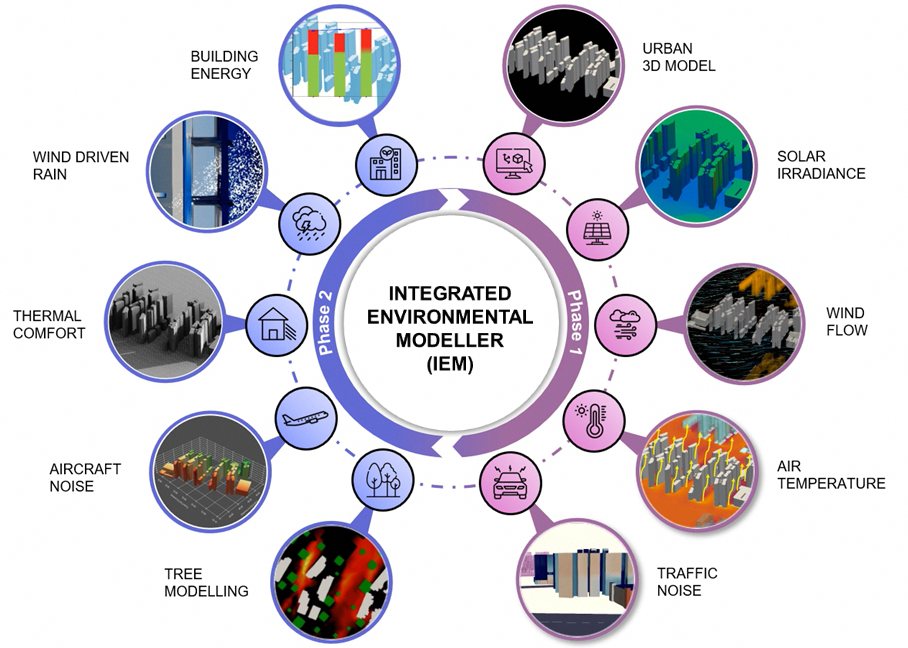
Overview of the IEM. (Housing and Development Board)