
Publication Op-eds
Towards the Regenerative City: The Next Leap for Urban Development
14 June 2026
By Chrisna du Plessis Professor of Regenerative Futures at the Department of Architecture, University of Pretoria, and co-author of Designing for Hope: Pathways to Regenerative Sustainability
Regenerative thinking goes further by embracing the idea of seva, or service, which suggests that human activity can actively enhance the capacity of ecosystems to thrive.— Chrisna du Plessis

Cities today face a convergence of crises—from climate instability to social fragmentation and resource scarcity—revealing the limits of a sustainability paradigm too often reduced to doing less harm. In an era that has already pushed past several planetary boundaries, this approach is no longer enough. As these limits draw nearer, cities have both the incentive and the responsibility to move beyond neutral ambitions and take a brave leap towards a regenerative future.
The stories we tell about sustainability also shape what we believe is possible. While the dominant narrative that leans on guilt and scarcity imagines a future of inevitable collapse, living systems show that endings also create space for new life. A regenerative narrative reframes the present moment as an opening for deep transformation and it offers an active form of hope, recognising that humans can contribute to the flourishing of life and that cities can become catalysts for co-evolution rather than places of extraction.
Reframing the Story of the Future
At its heart, regenerative development marks a profound shift in worldview. Instead of seeing the city as a machine to be optimised, it invites us to understand urban environments as living systems that are continually adapting and unfolding. Working from this perspective means shifting attention away from merely maintaining existing structures and trying to solve intractable problems. Instead, the focus is on identifying and nurturing potential and cultivating new possibilities. This shift reframes urban development through four key transitions: from reducing harm to generating net-positive value, from negotiating trade-offs to co-creating co-benefits, from human-centred design to mutually supportive human–nature relationships, and from linear resource flows to circular metabolic patterns.
Rethinking Humanity's Ecological Role
A crucial part of this shift involves rethinking humanity's place within the wider ecology. The move from an ego-centred stance, which emphasises dominion over nature, to an eco-centred perspective is already well recognised. Regenerative thinking goes further by embracing the idea of seva, or service, which suggests that human activity can actively enhance the capacity of ecosystems to thrive.
Ultimately, regenerative development is anchored in purpose. It is concerned less with meeting efficiency targets and more with nurturing the capacity of living systems to evolve in complexity, diversity and creativity. Regenerative cities are not simply more sustainable or resilient versions of what we already know. They represent a deeper transformation: urban places that heal relationships, nurture life, and unlock human and ecological potential. Just as a caterpillar must relinquish its old form to become a butterfly, cities too must be willing to shed outdated identities and open themselves to new possibilities.
Reconnection and Reciprocity as Catalysts for Transformation
This transformation begins with reconnecting people to place. Living systems offer powerful lessons for how cities can evolve. Regenerative cities pay close attention to the flows, forms and functions that characterise healthy ecosystems. They draw from the deep ecological and cultural identity of place, working with local soils, waters, seasons and communities. Regenerative design encourages people to attune to the local ecologies that sustain them and rediscover their role within the wider web of life. While biophilic design has shown that bringing nature into the built environment enhances human well-being, regeneration demands reciprocity. People must also contribute to the vitality of the ecosystems they inhabit. Many emerging projects already embody this principle by creating buildings and landscapes that enhance biodiversity, purify air and water, and strengthen social-ecological networks.
In time, regenerative cities behave like mature ecosystems. They are grounded in reciprocity and mutual support, and their economic and social systems prioritise net-positive contributions rather than individual gain. From this grounded understanding, it becomes possible to identify leverage points: small, strategic interventions that can set larger systems on a path of positive transformation.
New Life Grows from Broken Places
Embracing regeneration also requires accepting the role of creative destruction. Dysfunctional infrastructures and outdated paradigms must sometimes be allowed to collapse so that their latent potential can be reorganised into more resilient forms. In nature, collapse is not a failure. It is an essential step in renewal. Often, transformation begins at the edges where the old system is loosening—in the neglected spaces of failing infrastructure, storm-damaged neighbourhoods or decaying industrial landscapes. These liminal spaces can become fertile ground for regenerative possibilities to take root and reshape the city from within. With imagination and care, they can become the first places where regenerative possibilities set cities on a bold new path towards a more life-giving urban future.
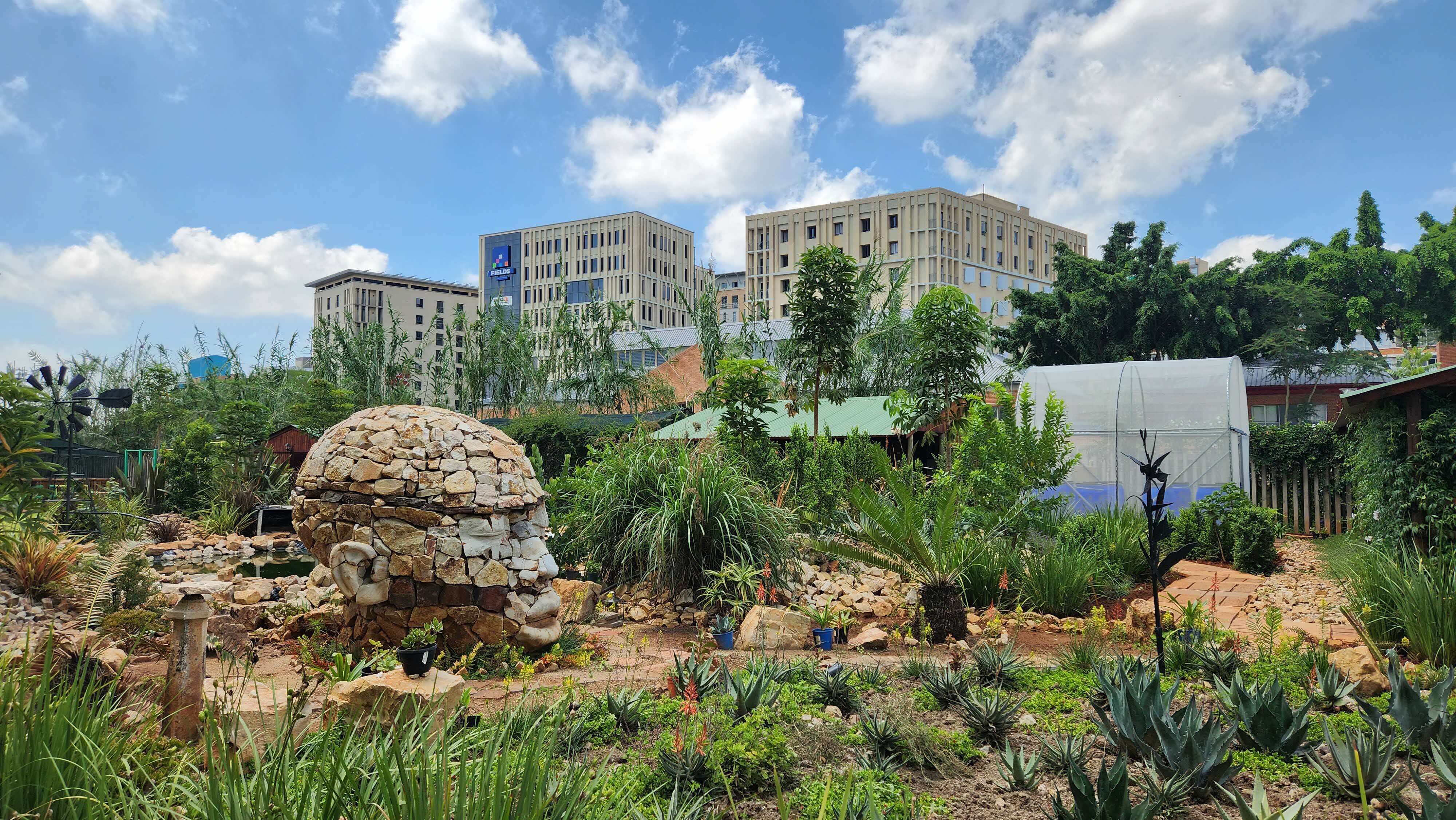
Regeneration emerging through the cracks at Moja Gabedi, a community garden in Hatfield, Pretoria, South Africa. This once-derelict urban wasteland was turned into a healing oasis for human and non-human inhabitants through community co-creation. (Chrisna du Plessis)
Cities as Key Drivers of Global Regeneration
Cities are uniquely positioned to lead this shift in thinking. Although they occupy only a small portion of the Earth's surface, their concentration of creativity, resources and influence makes them powerful drivers of global change. Regenerative actions taken at the neighbourhood or district scale can ripple outward to influence regional and even global cycles. By moving beyond the limitations of sustainability and embracing the city as a thriving, living system, it is possible to create urban environments that contribute to the enduring health and well-being of the entire planet. The regenerative approach stands as an invitation to engage with urban spaces as vibrant, co-evolutionary participants in the web of life.