
Publication Op-eds
The Living Algorithm: How Artificial Intelligence Shapes Regenerative Cities
14 June 2026
By Ang Yu Qian Assistant Professor (Presidential Young Professor), Department of the Built Environment, National University of Singapore
AI functions not merely as an optimisation tool, but as the analytical backbone required to synthesise complex ecosystems, built environments and human behaviours into a cohesive whole.— Ang Yu Qian

A static city measures its footprint; a living algorithm measures its pulse. At dawn, Singapore's built environment is already actively adapting. Behind this seamless orchestration, urban planners meticulously navigate complex sustainability trade-offs, guided by graph neural networks and explainable artificial intelligence (AI). Before the first commuters step onto the pavement, a highly localised network of microclimate sensors feeds real-time temperature, humidity and wind speed data into a hybrid physics-based and machine learning model. Anticipating the morning's specific thermal load and hot spots, buildings then autonomously adjust their cooling parameters, drawing on live urban building energy models. At the human scale, experience is subtly but profoundly shaped by visual perception models. Streetscapes are calibrated using AI-informed perception studies, aligning visual determinants with thermal comfort and psychological well-being.
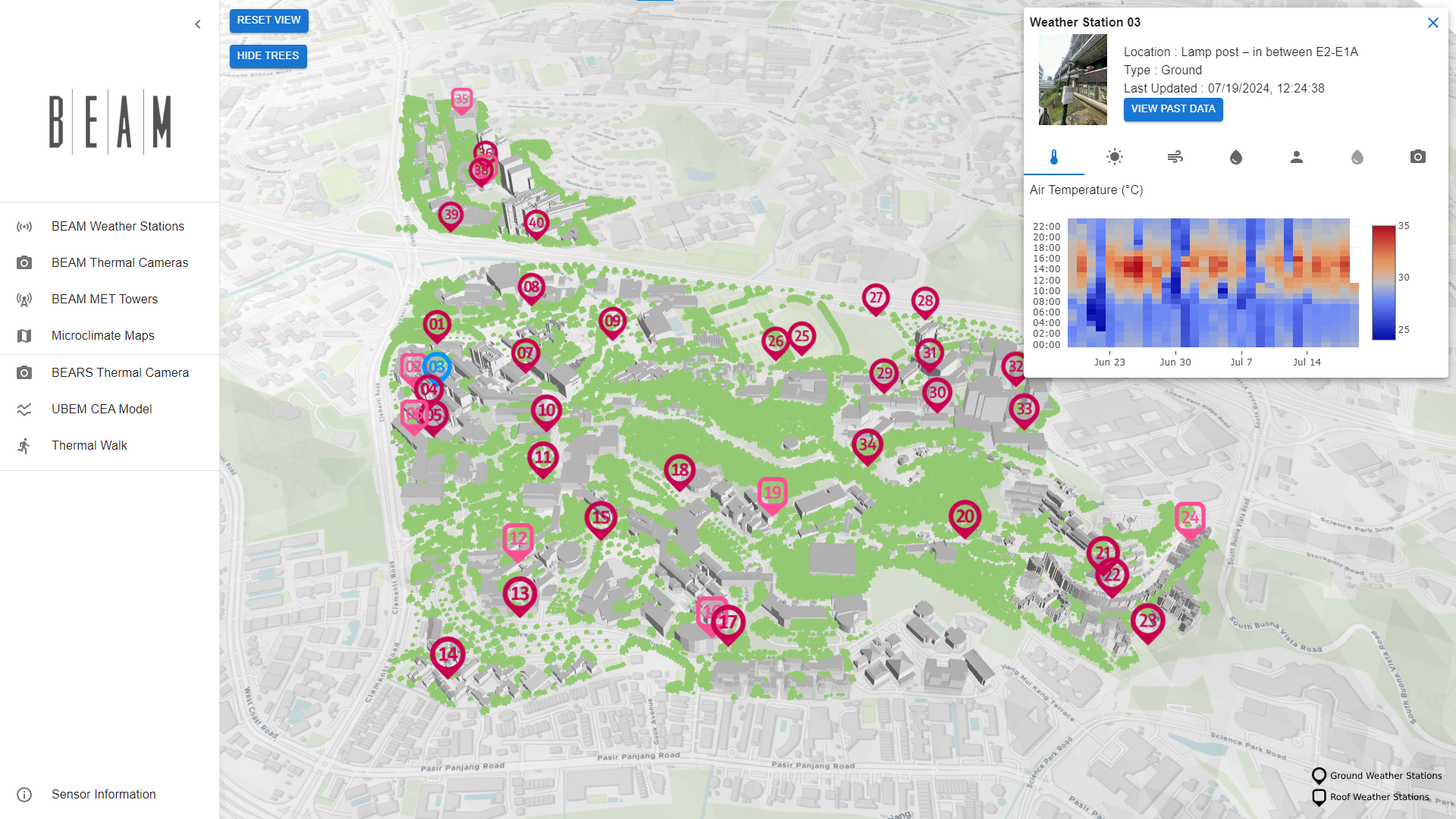
An overview of the CoolNUS-BEAM (Baseline, Evaluating, Action and Monitoring) Digital Twin and microclimate sensor network. Comprising 40 weather stations deployed at both ground and roof levels, 15-m-high meteorological towers, and rooftop infrared thermal cameras, this system forms one of the densest microclimate monitoring networks in the world. (Joie Lim / National University of Singapore)
This is the regenerative city in motion: an ecosystem that does not merely sustain itself but actively harmonises with its physical environment, generating net-positive benefits. By leveraging AI at multiple scales, the city transcends (basic) sustainability. These continuous micro-decisions seamlessly weave the Regenerative City Framework directly into the living algorithm of daily life.

An AI framework that helps planners understand and balance sustainability trade-offs across the city. Urban data—from building form and land use to connectivity—are represented as an interconnected network in graph neural networks. The model reveals how specific design features influence environmental impact and socio-economic vitality, enabling more informed planning decisions. (Xia Ye / National University of Singapore)
For decades, urban sustainability was defined by mitigation—a concept focused strictly on doing less harm. However, as global environments confront the escalating realities of a climate-changed future, the strict limitations of traditional sustainable development have become starkly apparent. To thrive, cities and municipalities are embracing regenerative design, a paradigm that shifts the goalpost from net-zero carbon emissions to net-positive outcomes. The new approach demands that urban spaces actively “heal” ecosystems and maximise co-benefits across environmental, social and economic domains.
Translating regenerative principles into built reality demands navigating thousands of interdependent variables (data)—from energy demand and thermal comfort to biodiversity, social equity and population health—within finite spatial and resource constraints. Managing these trade-offs exceeds the capacity of the human mind alone. AI provides the predictive and inferential foresight required to anticipate cascading effects across environmental, social and economic systems before any ground is broken.
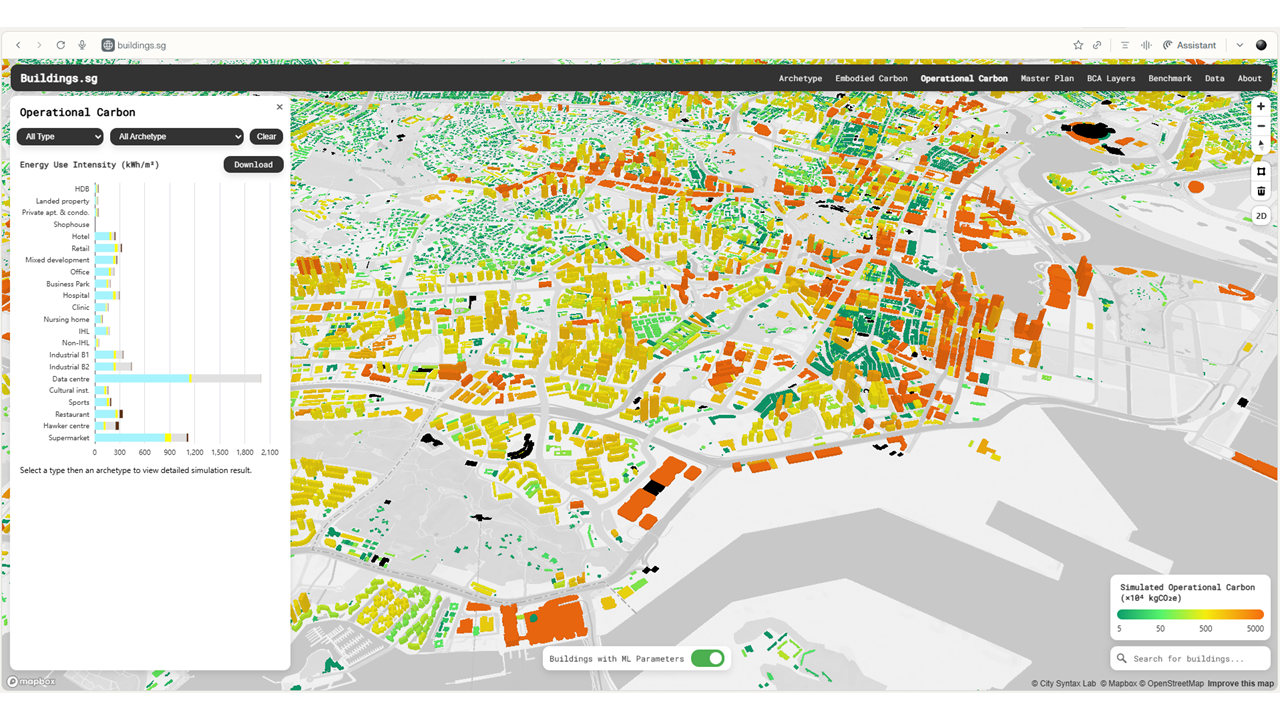
An interface view of Buildings.sg, an interactive urban energy and carbon map of Singapore. By integrating data across the built environment, it visualises building energy use, operational and embodied carbon, and Green Mark performance—supporting scenario planning and energy optimisation from the district to city scale. (Buildings.sg)
To achieve the vision laid out in the Regenerative City Framework, research (academia), government (policy) and industry (technology) must operate in close collaboration. AI functions not merely as an optimisation tool, but as the analytical backbone required to synthesise complex ecosystems, built environments and human behaviours into a cohesive whole. To build the city, we drafted blueprints; to regenerate it, we must decode its syntax. The cities that thrive in a climate-changed century will not be those that optimise once—but those that learn, adapt and evolve in real time.