
Publication Op-eds
Singapore's Water Story from the Regenerative Lens
14 June 2026
By Ong Tze-Ch'in Chief Executive Officer, PUB, Singapore's National Water Agency
Everyone in Singapore continues to play an important role in Singapore's water story, even as PUB builds on our past achievements and prepares to meet increased water demand.— Ong Tze-Ch'in

Water as an Existential Issue for Singapore
Since independence, Singapore's water supply has been an existential issue. At that time, we lacked enough water resources of our own within Singapore to meet the demands of our growing population and economy. We remain dependent on imported water from Malaysia. For many, Singapore's water story is synonymous with our Four National Taps—our diversified water supply portfolio of local catchment water, imported water, NEWater and desalinated water—and how they have collectively transformed our water supply into one that is sustainable and resilient.
Closing the Water Loop: NEWater
(20260429).png)
Singapore's water loop. (PUB)
PUB closed the water loop in Singapore with the introduction of NEWater—Singapore's brand of ultra-clean, high-grade recycled wastewater, which PUB produces from recycling both domestic and industrial wastewater. NEWater enabled PUB to reuse every drop of water endlessly, and through water recycling, to produce a multiplier effect on Singapore's finite water resources.
NEWater is designed to be potable, although today, most of it is sold to industrial customers who require high-purity water. Another major use of NEWater by PUB is to top up our impounding reservoirs scattered across Singapore. This then serves as indirect potable use of recycled water and strengthens the resilience of our water supply against climate risks.
Developing the NEWater tap has been a long journey for PUB and for Singapore—one that took decades and significant public buy-in. Since the 1970s, PUB had been tracking water recycling technologies across the world, notably in the United States. Eventually, in 2000, this led to the construction of a dual-membrane demonstration plant in Bedok to get the NEWater project going. We undertook a comprehensive 2-year study, supported by an independent expert panel, to ensure that the technology worked and the recycled water was safe.
More importantly, we needed to convince the Singaporean public that NEWater was safe to drink. The use of recycled water for drinking purposes has long faced resistance all over the world, and Singapore was no exception. We put out the findings of our expert panel—that NEWater's quality was consistently safe. We convinced our politicians to publicly support NEWater. All of these public communications efforts culminated in a “mass toast” of NEWater at Singapore's National Day Parade in 2002, led no less than by the Prime Minister himself.
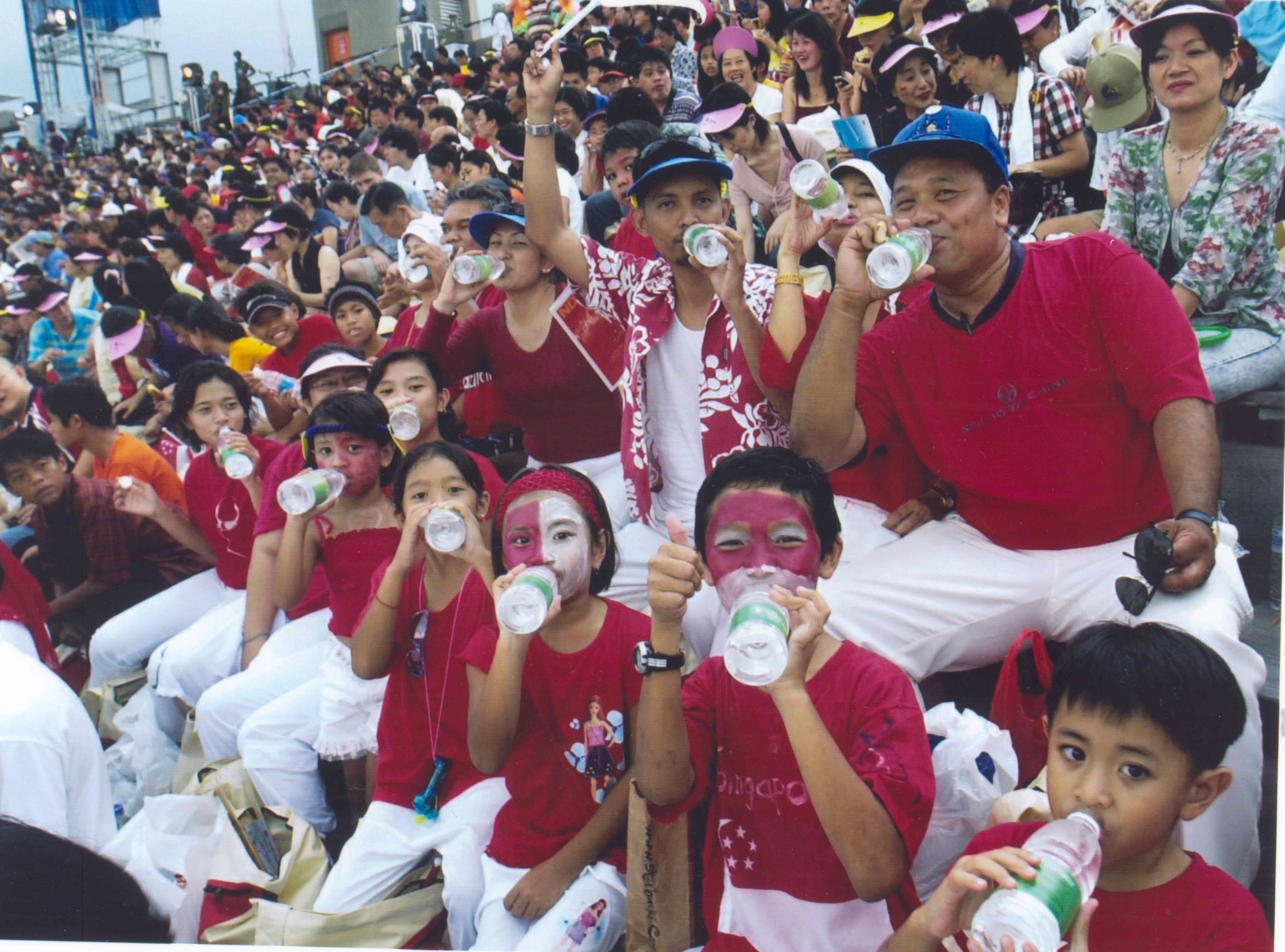
The Launch of NEWater at Singapore's 2002 National Day Parade. (PUB)
Managing Water Demand Through Conservation and Efficiency
Even as PUB grew our water supply and introduced new National Taps like NEWater, we were always clear that we needed to moderate the growth of water demand from both households and businesses. From the water resource perspective, Singapore's development needs to be sustainable over the long term.
Starting with the “Save Water” campaigns of the 1970s, the same message of water conservation carries on today with our Singapore World Water Day campaigns. We work with schools to raise awareness of water conservation among students and bring many water saving tips to families and households. We also introduced the Water Efficiency Labelling Scheme to provide consumers with information on the water efficiency of appliances and water fixtures. These efforts are intended to empower every individual in Singapore to make more informed choices and choose water-efficient products for their homes.
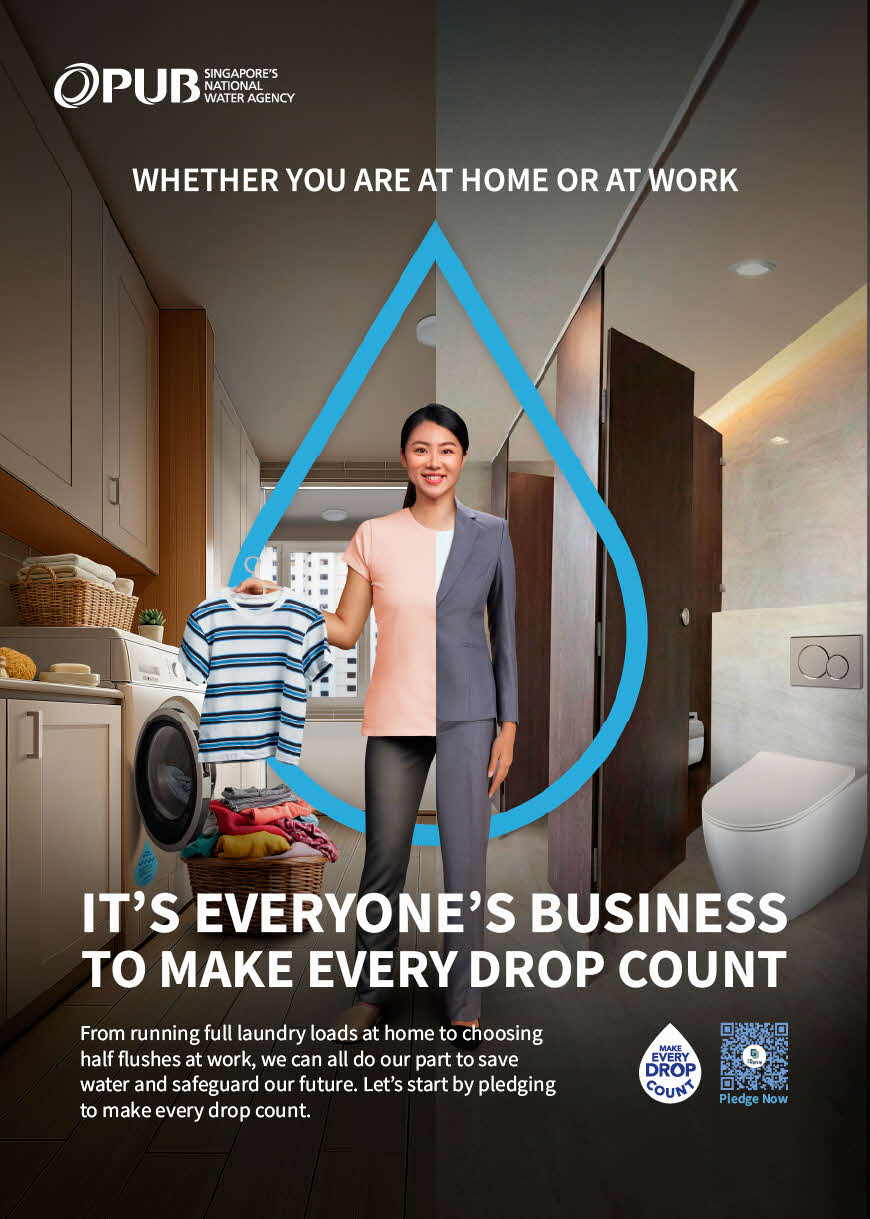
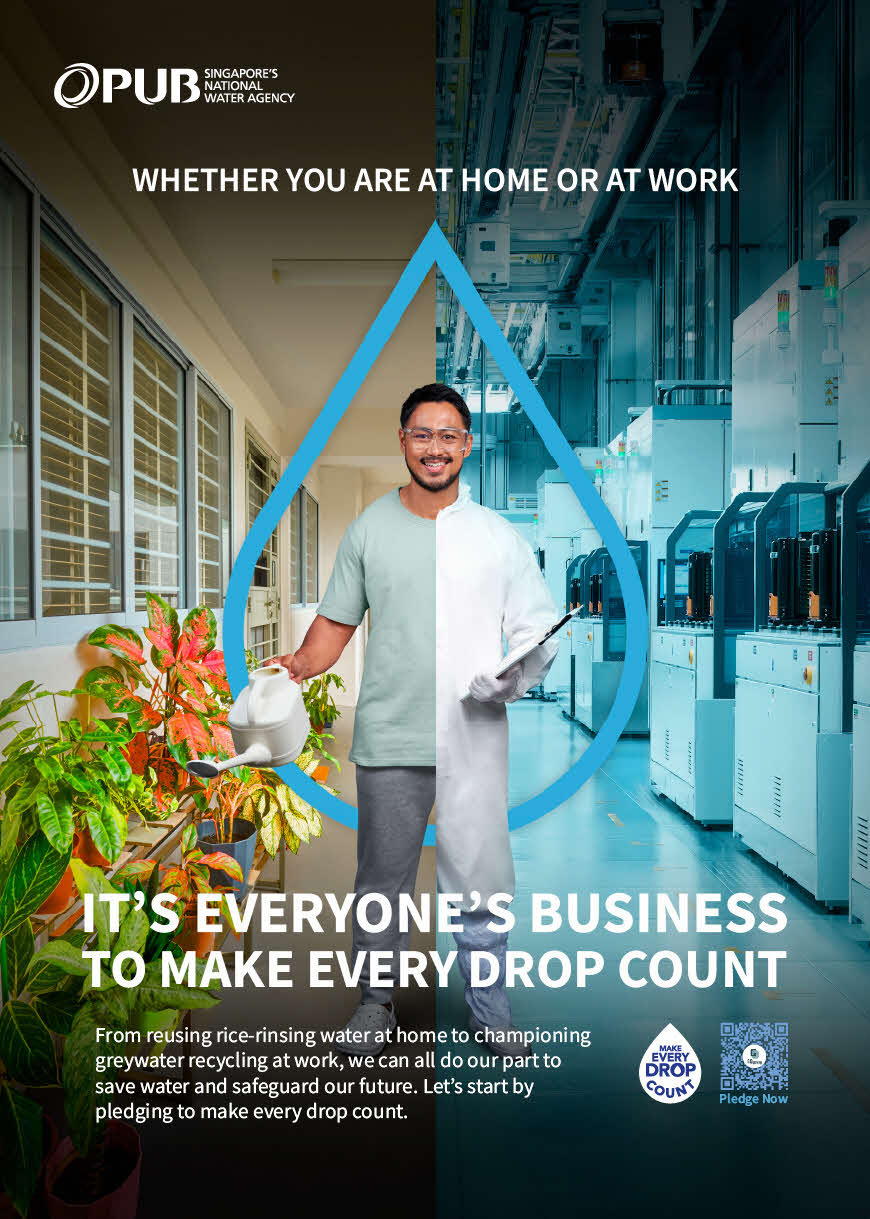
PUB has also implemented measures and initiatives to drive water conservation in the non-domestic sector. The first of these is right pricing of water. In Singapore, we price water at the marginal cost, i.e. the cost of producing and supplying the next drop of water. This ensures that companies take into account the true cost of water in their business decisions and work towards more water-efficient outcomes. The second is the use of grants under PUB's Water Efficiency Fund to incentivise companies to introduce water recycling in their plants and businesses, and to apply more water-efficient processes into their operations. With the non-domestic sector driving much of the future growth in Singapore's water demand, it is critical that our industries continue to prioritise water efficiency for long-term sustainable growth.
Conclusion
In an era of climate change, water becomes even more precious. Dry spells and droughts can easily disrupt the supply to homes and businesses. Everyone in Singapore continues to play an important role in Singapore's water story, even as PUB builds on our past achievements and prepares to meet increased water demand. My colleagues and I continue to work hard on this important mission of supplying good water to Singapore and Singaporeans.
This op-ed takes reference from Tan Yong Soon, Lee Tung Jean and Karen Tan's Clean, Green and Blue: Singapore's Journey Towards Environmental and Water Sustainability (Singapore: Institute of Southeast Asian Studies, 2008).