
Publication Op-eds
Punggol Digital District: A Blueprint for Sustainable Mixed-Use Development
14 June 2026
By Jacqueline Poh (JTC Corporation) and David Tan (JTC Corporation)
Jacqueline Poh is the Chief Executive Officer of JTC Corporation, Singapore.
David Tan is the Assistant Chief Executive Officer (Development Group) of JTC Corporation, Singapore.
[Punggol Digital District] demonstrates that urban development can transcend traditional trade-offs between density and liveability, economic growth and environmental sustainability, innovation and community cohesion.— Jacqueline Poh and David Tan
Pioneering Singapore's First Smart and Sustainable District
Singapore's Punggol Digital District (PDD) represents a fundamental reimagining of urban development, demonstrating how cities can integrate design innovation, smart systems and collaborative ecosystems to address contemporary urban challenges. As spatial challenges rise in dense cities along with climate pressures, the PDD is a representative model for sustainable, connected and adaptive urban environments that prioritise both ecosystem building and environmental stewardship.
Reimagining Urban Form: Interconnectedness Below the Inverted Skyline
Most urban districts face a fundamental spatial challenge: how to accommodate dense built-up spaces whilst maintaining liveable environments and preserving nature. Traditional approaches often result in ground congestion where transportation networks and building services compete for limited space, creating fragmented urban environments that cannot address interconnected challenges of climate change, energy resilience and community integration. The PDD addresses this through innovative spatial organisation that treats the district as a 3-dimensional ecosystem rather than a conventional 2D master plan.
The district's most striking feature is its "inverted skyline" configuration, developed by WOHA Architects, that reverses the typical urban form. Rather than an upward "bar graph" skyline that limits solar renewable energy collection, the PDD's inverted massing approach introduces a broad rooftop canopy layer hovering above connected public spaces and preserved green spaces below. This design maximizes usable roof area while creating sheltered ground level environments that prioritize human comfort and community interaction in a tropical environment.
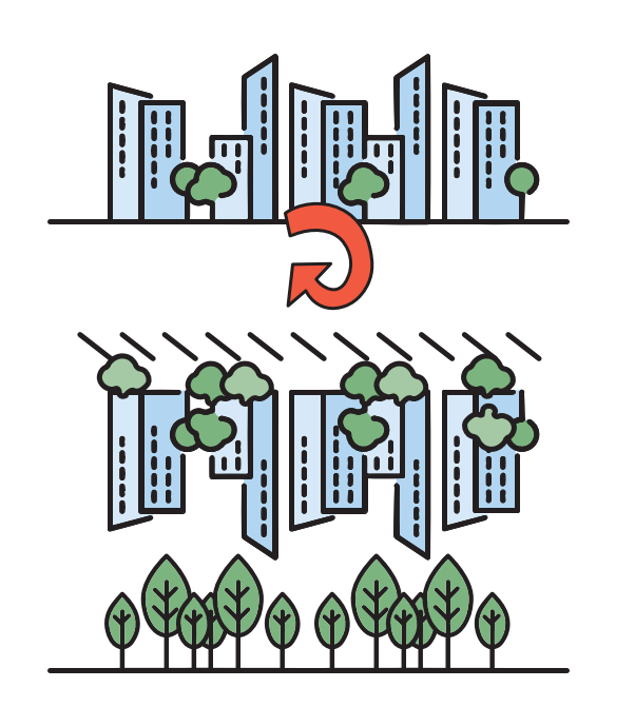
"Inverted skyline" concept. (WOHA)
Beneath the distinctive skyline, the PDD prioritises pedestrian connectivity through the strategic organisation of infrastructure. All heavy vehicle servicing, carparks, pneumatic waste bins and infrastructure such as a substation and district-cooling system are lowered into a subterranean network, reserving the ground level for the people. The district creates a fully walkable and car-lite environment with the pedestrianised Campus Boulevard at its heart. This is seamlessly connected to the Punggol Coast MRT station, Punggol Coast bus interchange and cycling networks that provide links across Singapore. The 2-km Collaboration Loop at the 7th storey level further enhances connectivity by linking buildings through social nodes and indoor amphitheatres.
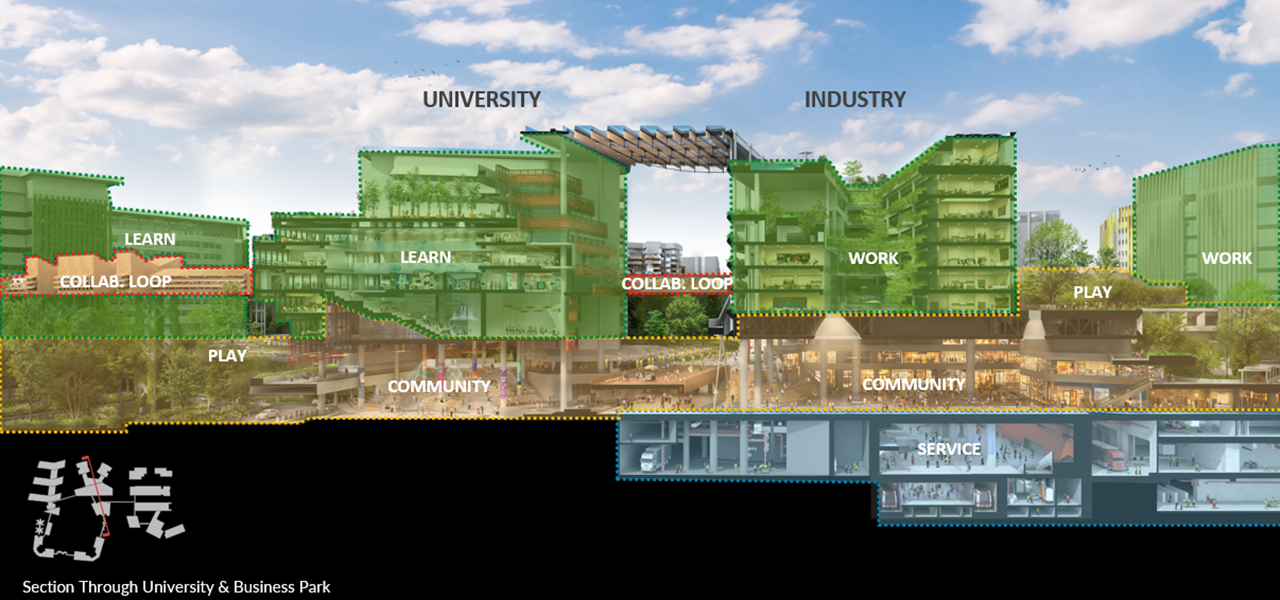
A section through the PDD's business park and university spaces, with seamless community spaces on the ground plane and services underground. (WOHA)
This interconnectedness enables a new model of nature-human cohabitation where additional lush green spaces and conserved trees create an urban park interwoven throughout the Business Park district, achieving a 100% landscape replacement area. The result is a district where the built and natural environments enhance rather than compete with each other, creating breathing spaces that serve both ecological and community functions and provide better stormwater management, urban heat island reduction, carbon sequestration and pollution mitigation.
Collaborative Ecosystems: An Integrated Mixed-use District
The PDD redefines the relationship between education, industry and community through an integrated mixed-use model that responds to evolving patterns of work, live, learn and play. Accommodating 28,000 workers and 12,000 students, the development fosters continuous interaction between students, researchers, entrepreneurs and established businesses within a shared ecosystem.
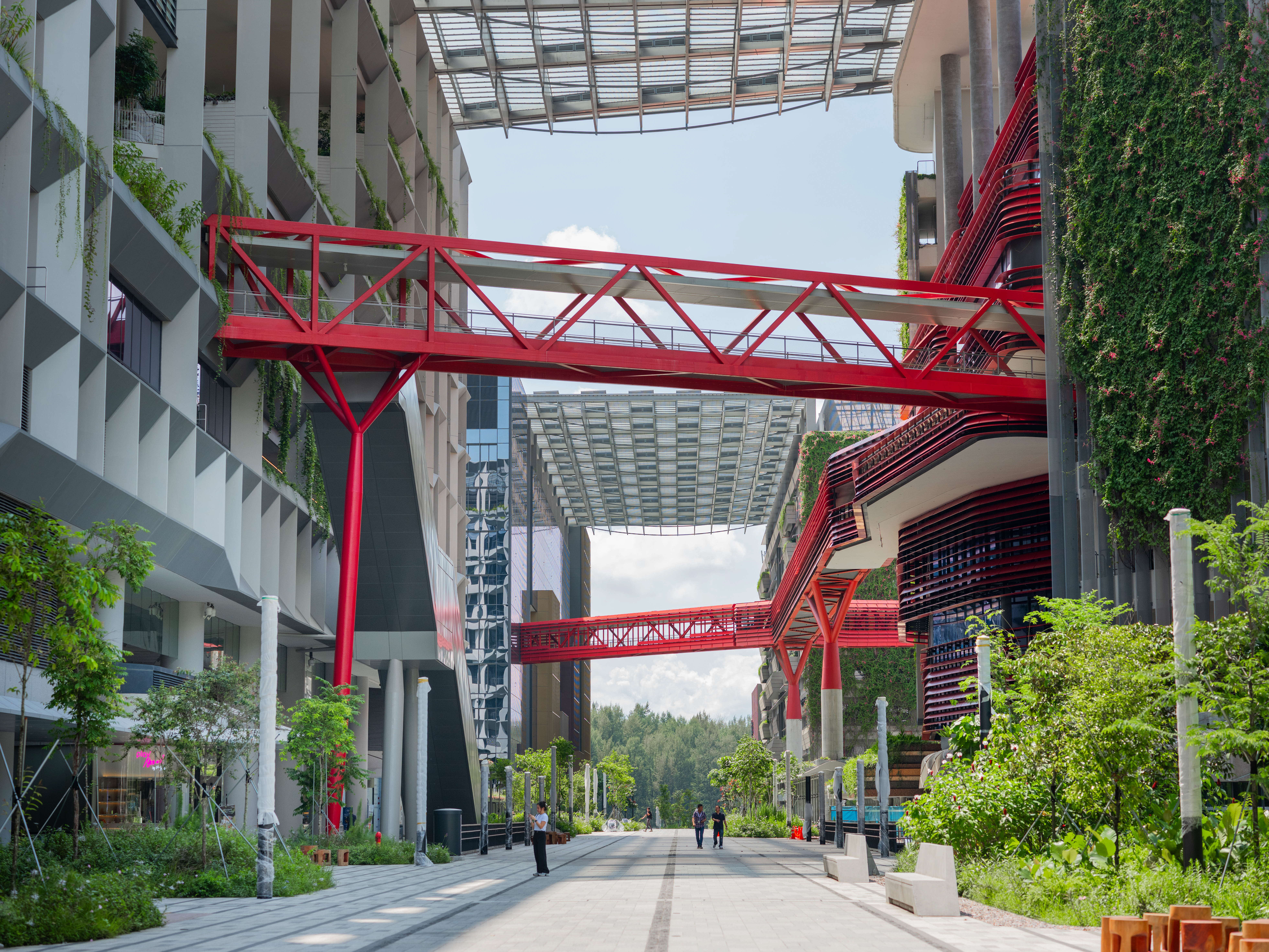
PDD Campus Boulevard with Collaboration Bridges connecting JTC Business Park spaces and SIT. (JTC Corporation)
At the heart of this approach lies the Enterprise District model, which introduces unprecedented development flexibility by allowing space transfers between different land parcels, and even "space swaps" between the Singapore Institute of Technology's campus and JTC's business park facilities. The flexibility enables Gross Floor Area (GFA) transfers, allowing academic and business functions to adapt dynamically over time, with students accessing industry-standard laboratories while companies tap into talent and research capabilities. By eliminating institutional silos, this model creates direct collaboration opportunities that would otherwise be physically separate zones.
The district strategically targets high-growth digital sectors including cybersecurity, artificial intelligence, robotics, FinTech and Smart City solutions. Beyond established industry players anchoring the business park, JTC will develop a new LaunchPad@PDD as a dedicated startup incubator, giving emerging companies access to both commercial partnerships and academic research capabilities. This creates pathways for startups to leverage the district's ecosystem and resources while enabling established companies to tap into fresh innovations.
The mixed-use integration extends to comprehensive community infrastructure, with childcare facilities, healthcare services, recreational areas, the Punggol Coast Mall, and a hawker centre serving both the district's workforce and students alongside neighbouring Punggol residents. This creates a polycentric district where educational, commercial and residential functions overlap naturally rather than operate in isolation. The result is a connected ecosystem that strengthens both professional networks and community ties.
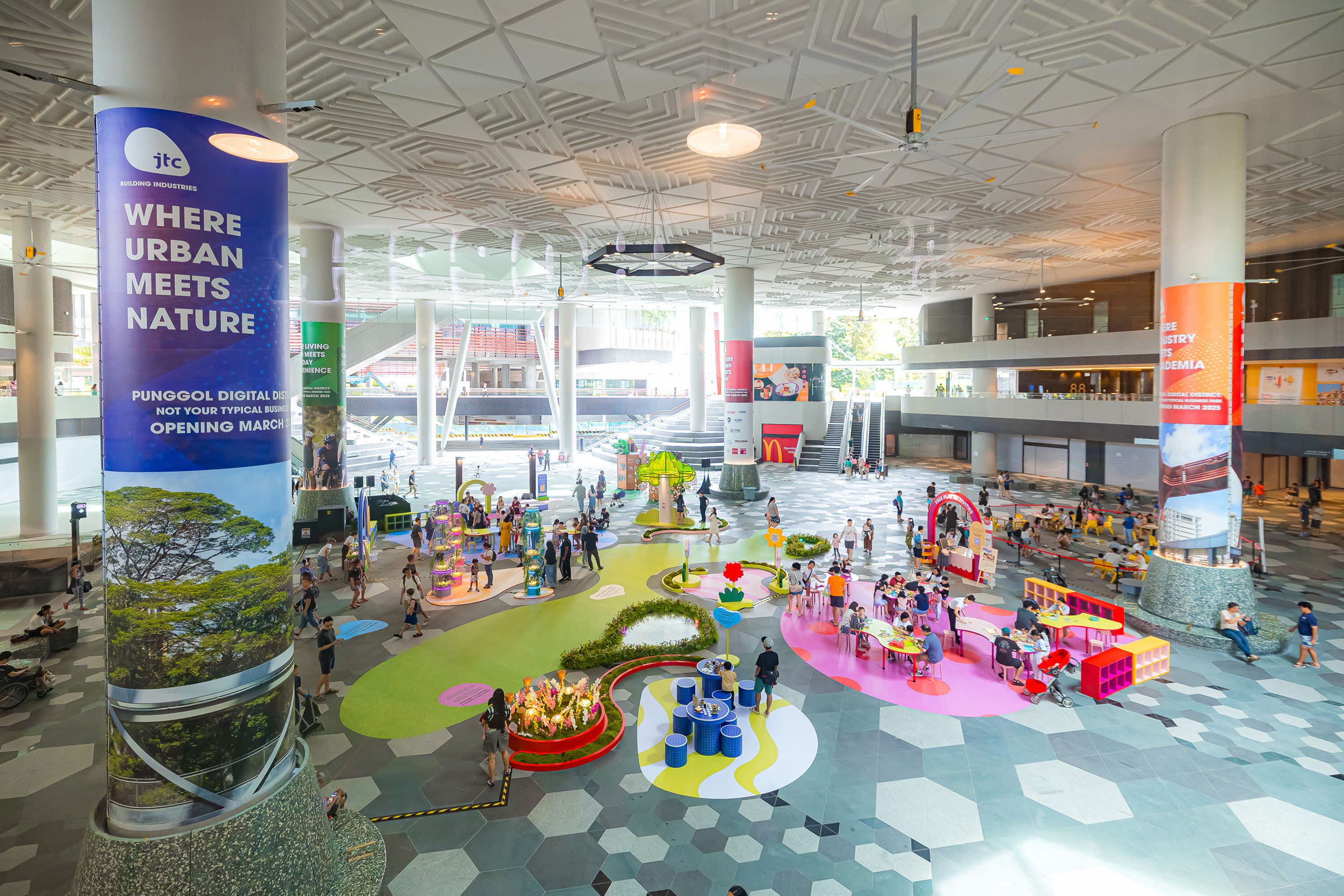
Nexus of Punggol Coast Mall. (JTC Corporation)
Smart Systems: Digital Urban Operating System
The PDD's comprehensive smart infrastructure transforms the district into an intelligent environment that operates as a living lab for smart city technologies. This digital foundation creates a responsive learning system where data-driven insights continuously optimise performance and enable real-world innovation, testing and deployment across all district functions.
Singapore's first Open Digital Platform drives this transformation through a 3D digital twin that integrates smart city solutions across the entire development. Over 20,000 sensors embedded throughout the district collect real-time data on building performance, occupancy patterns, environmental conditions and energy consumption. Artificial intelligence and machine learning algorithms can process this continuous data stream to achieve up to 20% energy savings, while predictive and preventive maintenance systems reduce operational downtime and repair costs, supporting rapid deployment and testing of smart solutions in live environments.
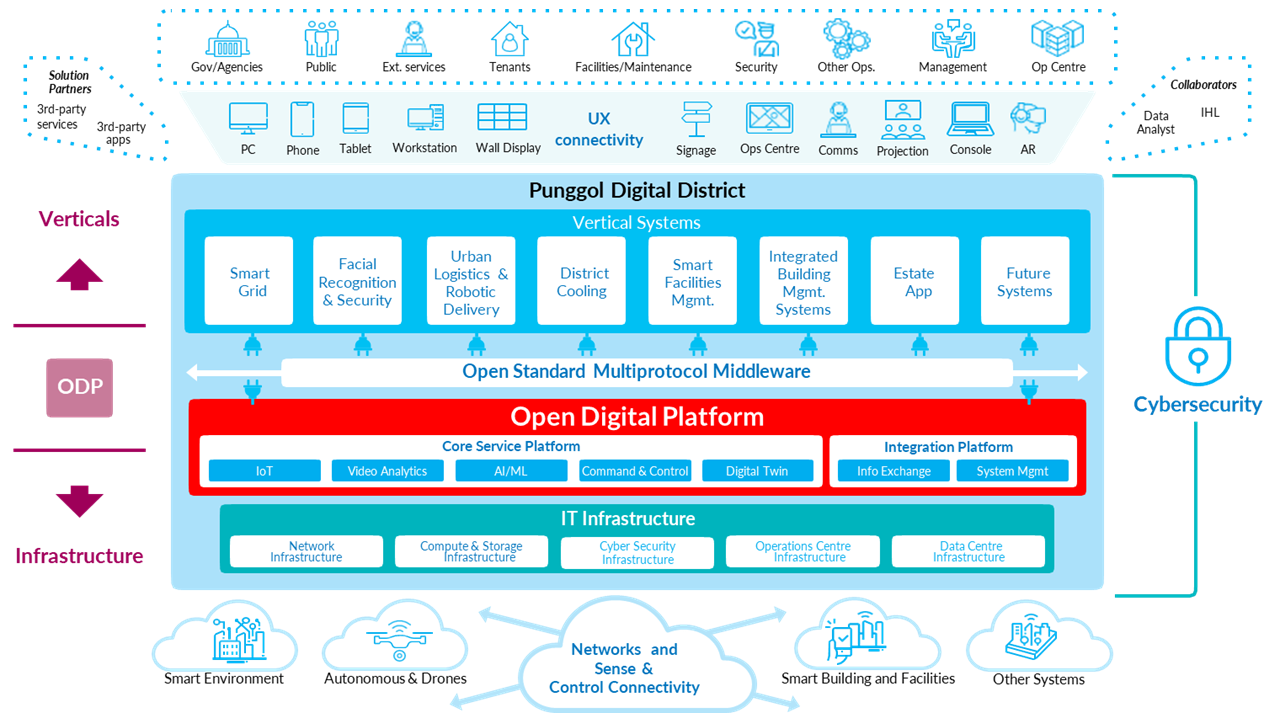
The PDD's Open Digital Platform. (JTC Corporation)
The digital twin also serves as a virtual testing ground where companies can simulate scenarios, optimise operations and validate innovations. This digital-first approach significantly accelerates the time to market for new technologies while supporting long-term planning and maintenance. The platform provides real-world sustainability data that deepens understanding of environmental stewardship and smart city principles while enabling continuous experimentation and refinement.
Smart Systems: Supporting a Greener District
Integrated smart systems deliver substantial environmental benefits through Singapore’s first urban district-level smart grid that optimises energy distribution and storage within photovoltaic canopies. Through extensive rooftop solar installations, the district generates over 3,000 MWh annually—equivalent to powering 11,000 3-room HDB flats—while achieving a 35% reduction in annual carbon emissions, equivalent to removing 4,000 cars from Singapore's roads.
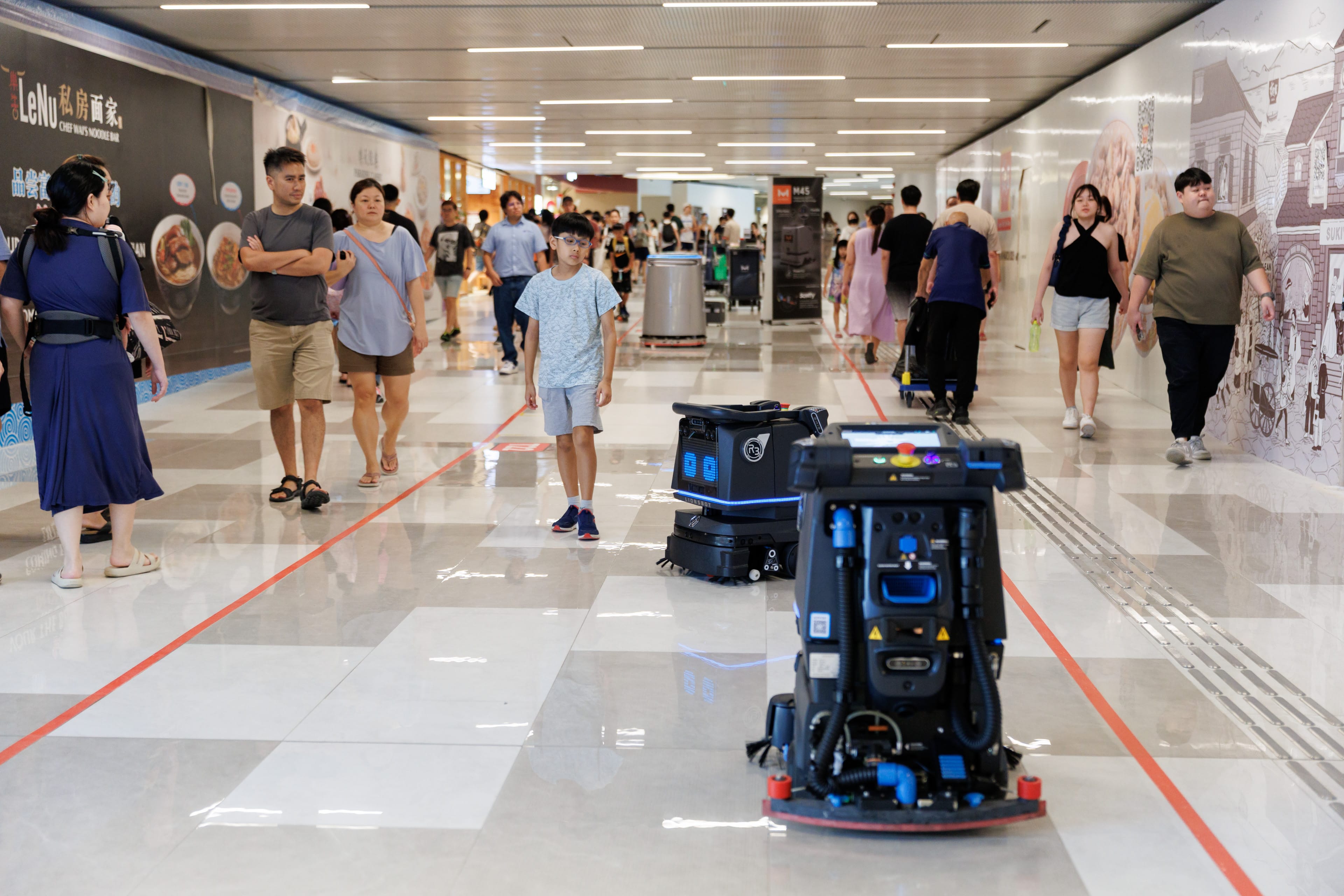
Smart technology and robotics are deployed and testbedded at the PDD. (JTC Corporation)
Beyond the PDD: Scaling the Smart and Sustainable District Blueprint
The PDD demonstrates that urban development can transcend traditional trade-offs between density and liveability, economic growth and environmental sustainability, innovation and community cohesion. Through its integration of spatial innovation, smart systems and collaborative ecosystems, the district establishes a replicable blueprint for cities worldwide that are seeking to address climate challenges while fostering human connection and economic dynamism. As urban environments continue to evolve under mounting pressures, the PDD's holistic approach—where physical design, institutional flexibility and digital intelligence work in concert—offers valuable insights for creating resilient, adaptive and thriving urban communities that serve both present needs and future aspirations.