
Publication Op-eds
Leveraging the Circular Economy Potential of Existing and Future Built Assets
14 June 2026
By Rudi Stouffs Associate Professor and Assistant Dean (Research), Department of Architecture, National University of Singapore
The work points to the significant gains that can be made in adopting computational technologies to operationalise circular economy strategies at the district-scale that are key to realising closed-loop systems.— Rudi Stouffs

The construction industry is a major contributor to greenhouse gas emissions (GHG), with a significant portion of these emissions being embodied in construction components and materials. An opportunity to reduce these embodied emissions lies in the circular economy (CE). However, current practices rarely fully leverage the circular economy potential (CEP) of existing and future built assets. We identify three key barriers.
One key barrier is the lack of material information about the current building stock. Studies modelling building material stocks (BMSs) have demonstrated the potential to reduce primary material consumption and environmental impacts at a district scale (such as carbon emissions) by modelling the CE material flow of recycling. However, BMS modelling is data intensive, relying on complete material and component characteristics of various types of buildings. Data scarcity is a fundamental challenge many regions and districts face, especially material content data. Using AI-enabled methods that integrate building similarity measures may overcome these limitations, mapping material data to similar buildings, forming and enriching a cohesive dataset, and enabling incremental larger-scale BMS aggregation.
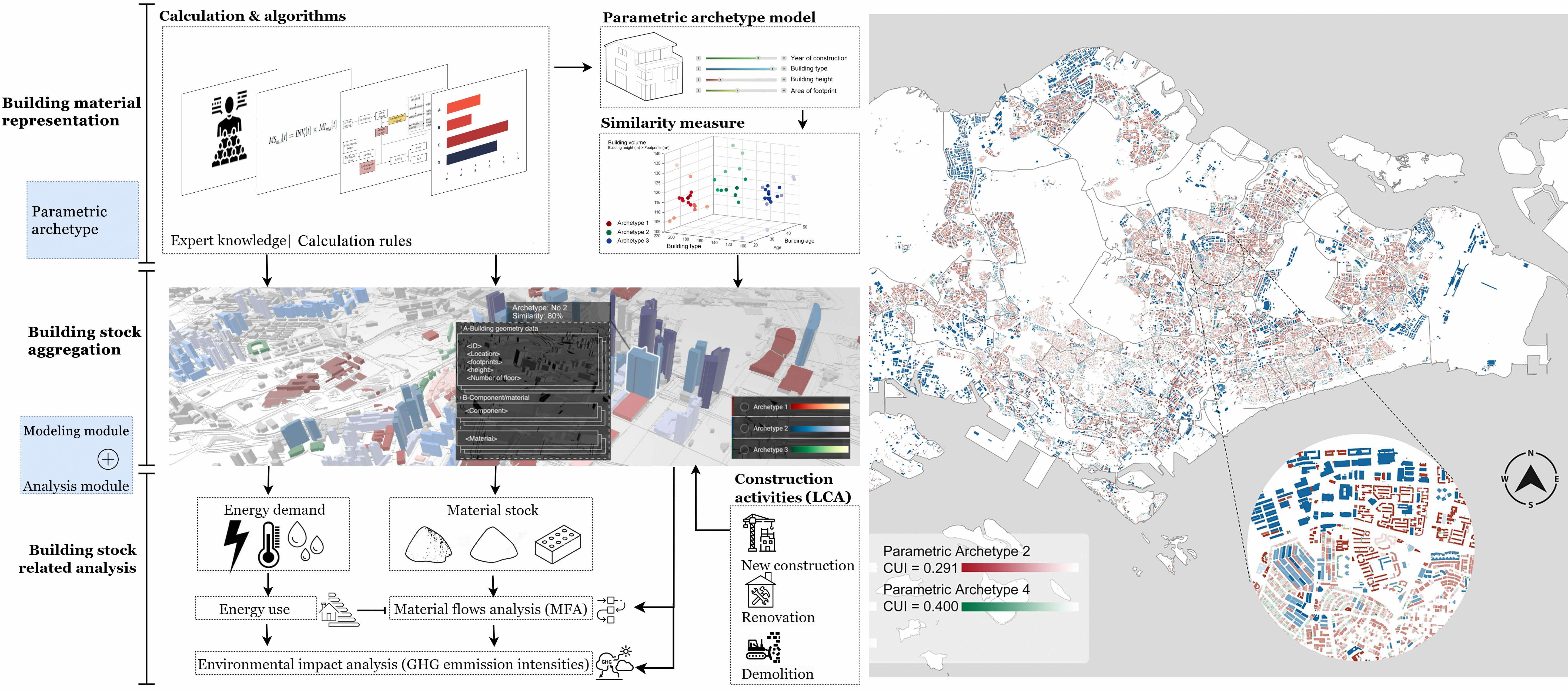
Application of the parametric archetype method to urban building material stock aggregation and analysis in a data-scarce environment. (Rudi Stouffs and Wanyu Pei)
A second key barrier is the difficulty to access construction resource information and to conduct relevant analyses using this information. Embedding building material data with operational data about the built environment (including building energy use) into an urban digital twin (UDT) application enables the visualisation and analysis of outcomes related to whole life carbon assessment (WLCA). Such a platform facilitates data-driven decision-making for policymakers, urban planners and stakeholders in the building sector, focusing on whole-life carbon, material recycling, circularity and climate action.
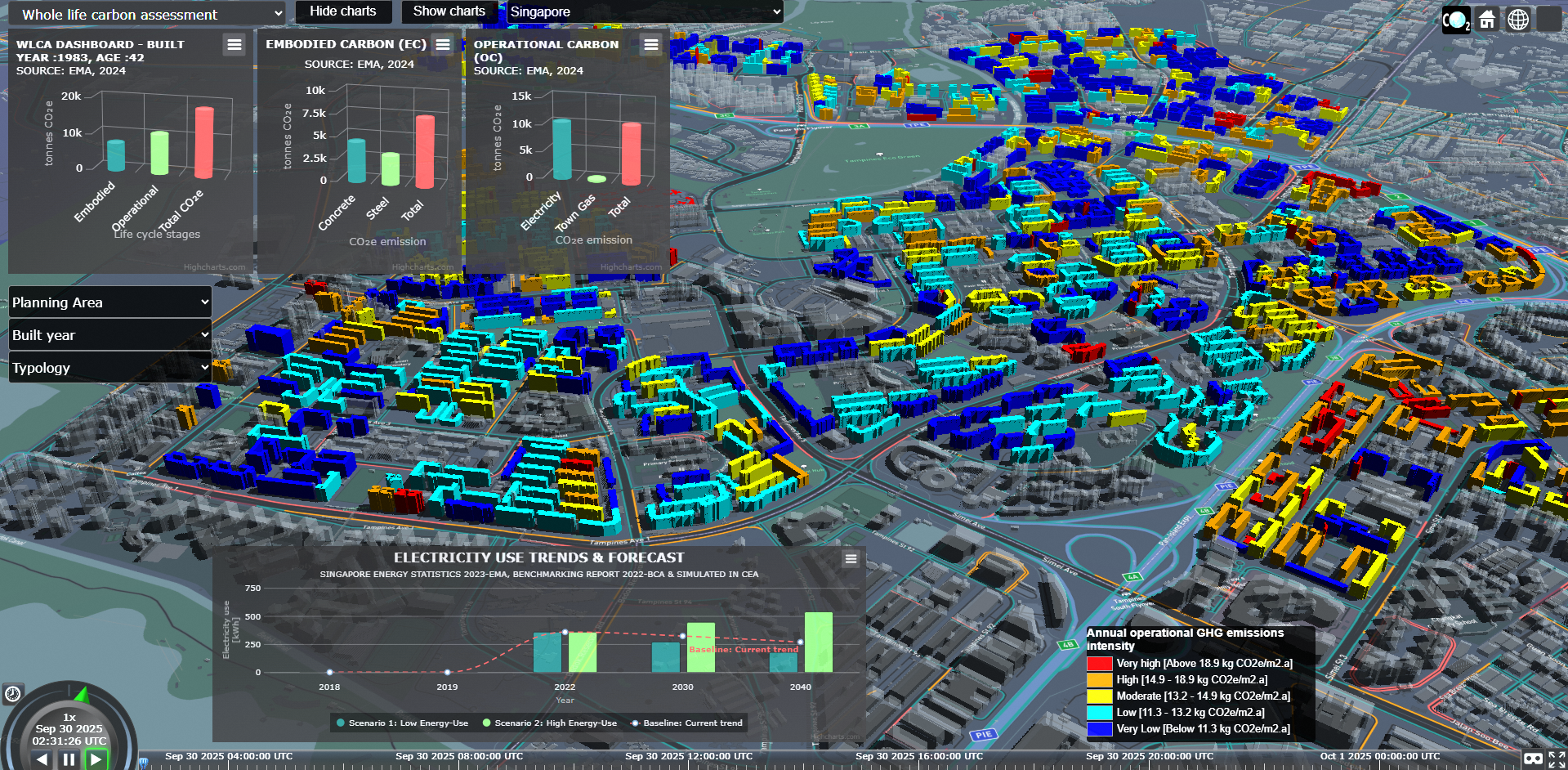
Screenshot from the GHG app, which provides whole-life cycle carbon assessments for buildings in Singapore, covering both operational and embodied carbon. The dashboard displays indivdual building electricity usage trends. (Rudi Stouffs and Pradeep Alva)
A third key barrier is the lack of a holistic quantification method that can be applied to both existing and new designs. Current design quantification methods apply mostly for the modelling of the recovery potential of construction material. However, the value and recovery potential of resources depend on more than their mass alone and it is useful to consider CE strategies preserving higher embodied values. Such a method should consider multiple CE objectives, such as keeping the constituents of a built structure in place (longevity), reusing them in a similar form (reusability), or changing their form through processes like recycling or decomposition (transformability). Although not all information required is available within Building Information Modelling (BIM) models, a BIM environment serves as an excellent base to extract relevant data or even embed such a holistic tool.1
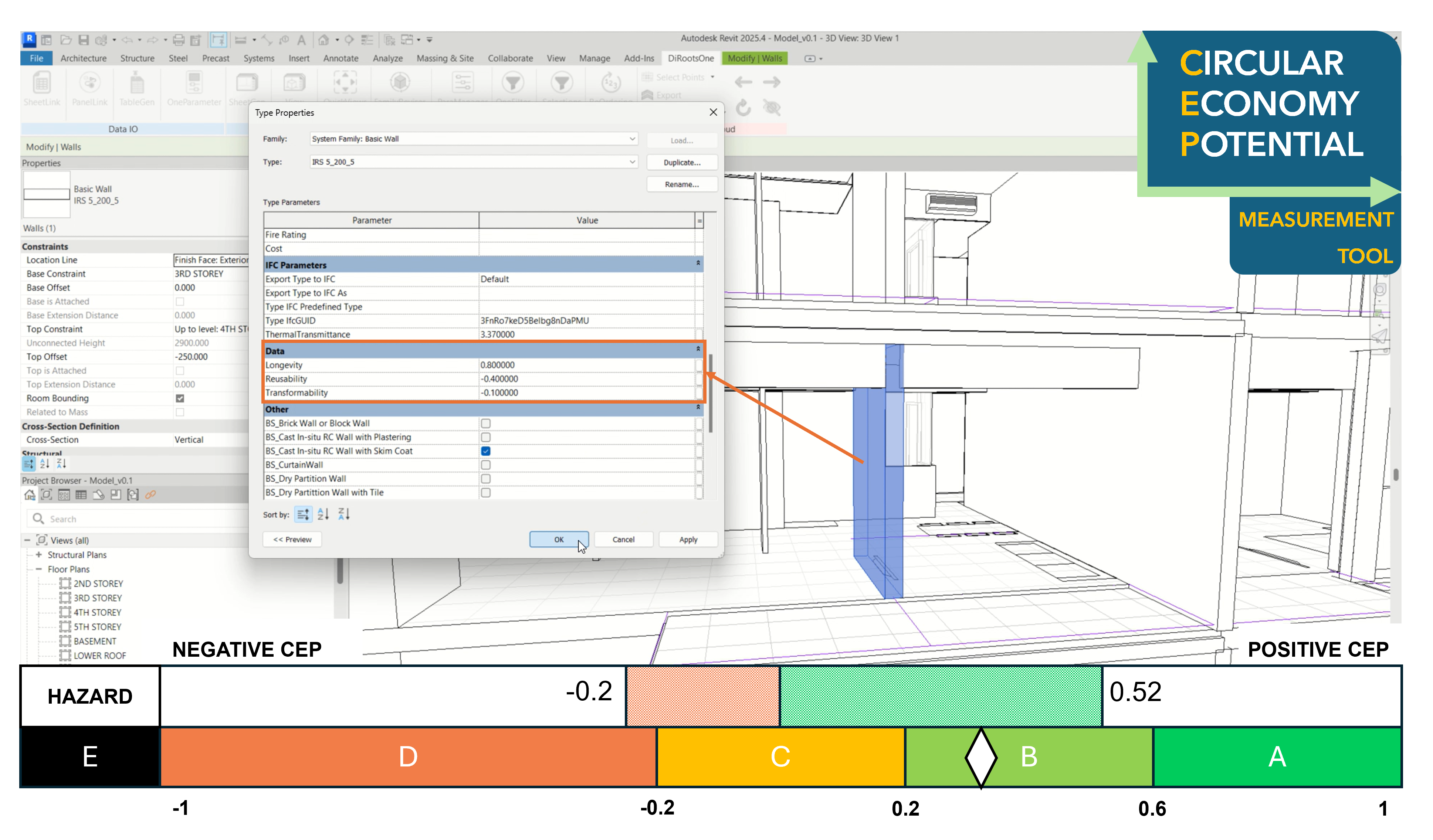
Screenshot of the CEP measurement tool developed in the Revit environment, showing a component with assigned longevity, reusability and transformability parameters, and the resulting calculation of the built asset's CEP classification (class B), including indicated negative and positive CEP values. (Rudi Stouffs and Goran Sibenik)
In the Circular Future Cities module of the Future Cities Laboratory (FCL) Global research programme at the Singapore-ETH Centre (SEC), we have explored and developed tools to address each of these three barriers, including a parametric archetype method for BMS modelling in urban districts with scarce material data, a GHG app implementing a UDT supporting WLCA and the analysis of potential recyclable materials in buildings, and a CEP measurement tool providing a practice-orientated approach to measuring circularity that can be applied to digital models of built assets. The work points to the significant gains that can be made in adopting computational technologies to operationalise CE strategies at the district-scale that are key to realising closed-loop systems.
Endnote
[1] BIM captures detailed material and component data for individual buildings, and can serve as a key data source for BMS modelling at the district or urban scale.