
Publication Op-eds
From Garden City to City in Nature: How Singapore's Green-Blue Networks Embody Regenerative Urban Living
14 June 2026
By Hwang Yu-Ning Chief Executive Officer, National Parks Board, Singapore; With Charlene Ng, Director, Science and Technology Planning, National Parks Board
... regenerative cities are complex, dynamic systems capable of thriving in climate-changed and resource-constrained futures.— Hwang Yu-Ning
Singapore's transformation from a nation that had lost 95% of its original forest cover by 1930 to the thriving City in Nature that it is today exemplifies the four key paradigm shifts of the regenerative approach: from avoiding bad to doing good, from trade-offs to co-benefits, from human-centric thinking to fostering human-nature relationships, and from end-of-life to closed-loop planning. Our journey demonstrates that even the most urbanised environments can become net positive for both human communities and natural ecosystems.
Regenerative Principles in Practice
The Nature Conservation Masterplan (opens in new tab) and City in Nature (opens in new tab) strategies embody regenerative city principles of systemic thinking, dynamism, and ethical stewardship. Rather than viewing green spaces as isolated amenities, we approach our island holistically as an interconnected ecosystem where nature-based solutions create multiple co-benefits across urban systems.
Density: Maximising Regenerative Capacity
Within our extreme land constraints, Singapore demonstrates how concentrated restoration interventions can yield disproportionate benefits. Our four nature reserves and expanding nature park networks exemplify the use of nature-based solutions in the city.
The Framework Species Method, where 20 to 40 native plant species are selected to rapidly accelerate biodiversity recovery, has been used to support the creation of integrated, multifunctional developments that serve both ecological and human needs.
The Singapore Botanic Gardens Learning Forest's freshwater wetland restoration showcases this approach well. This single site has created multiple regenerative outcomes: restoring hydrological processes and delivering clean water to the Swan Lake, regenerating lowland rainforest, creating refuge for threatened freshwater flora and fauna, and providing educational and recreational opportunities for visitors to enjoy. By 2026, over 300 hectares of such naturalised gardens and parks will demonstrate how strategic density can optimise for co-benefits across liveability, resilience and resource domains.
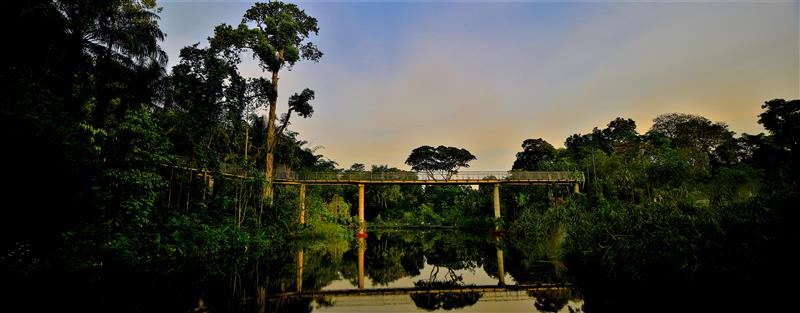
A lowland rainforest and freshwater wetland restoration project on a 10-hectare site led to the delivery of multiple regenerative outcomes—the delivery of clean water to the Swan Lake, refuge for threatened freshwater flora and fauna, as well as an educational site for visitors to enjoy. (National Parks Board)
Diversity: Ecosystem Richness as a Climate Foundation
Singapore's habitat diversity—from lowland dipterocarp forests to mangroves, and from freshwater swamps to coral reefs—forms the foundation for ecological, climate and social resilience.
Our restoration methods demonstrate dynamism, ranging from assisted natural regeneration like the successful Pulau Ubin mangrove recovery [PDF, 1.19 MB] (opens in new tab) to active maximum diversity approaches for isolated urban sites.
We prioritise keystone species like native figs (Ficus spp.), which create circular, closed-loop ecological systems that support diverse fauna year-round. Crucially, we restore all successional stages of the ecosystem rather than focusing solely on climax ecosystems.1 This approach builds regenerative capacity for unknown climate futures. It recognises that ecological resilience requires complete ecosystem representation, not merely individual species conservation.
Connectivity: Living Networks Through Systemic Thinking
Our ecological corridor network, which links Singapore's nature reserves to heartland parks, embodies regenerative infrastructure that operates across multiple scales. Projects like Thomson Nature Park incorporate connectivity planning for species like the critically endangered Raffles' Banded Langur, demonstrating ethical stewardship where both humans and nature act as co-creators.
.jpg)
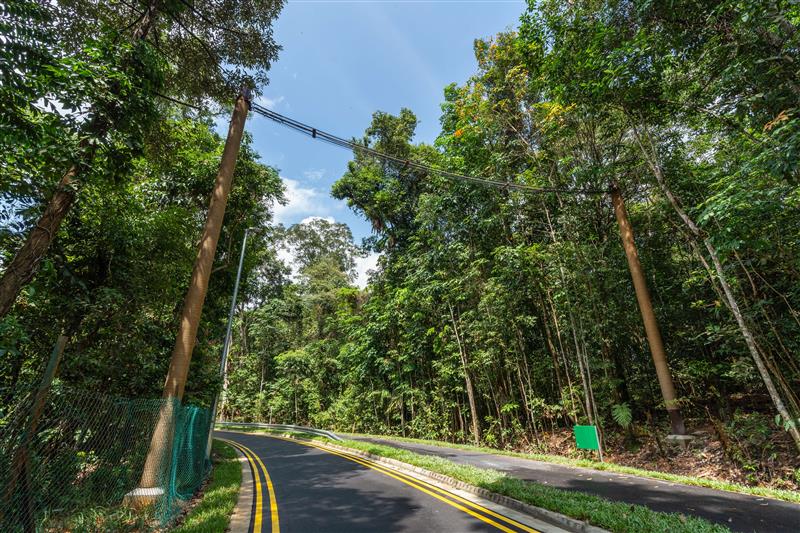
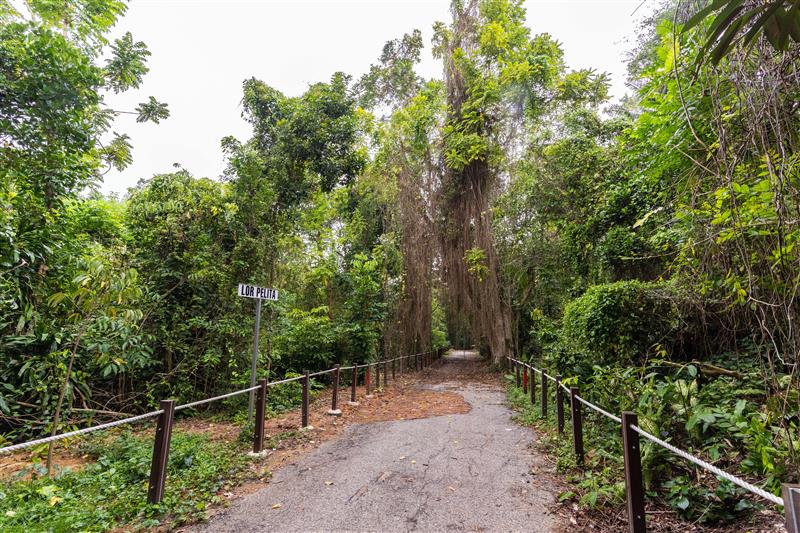
The vision of every road as a nature way [PDF, 2.62 MB] (opens in new tab) creates integrated developments serving both human mobility and wildlife movement. Taking such a systemic approach, guided by adaptive management principles, enables continuous learning through experimentation and reflection on how urban development affects nature.
.jpg)
.jpg)
Measuring Regenerative Outcomes
Singapore pioneered systematic measurement of urban regenerative capacity through the Singapore Index on Cities' Biodiversity (SI), (opens in new tab) developed in 2008 with the Convention on Biological Diversity Secretariat. This 28-indicator framework measures native biodiversity, ecosystem services and governance—aligning with regenerative principles of tracking co-benefits for people and nature.
Our long-term socio-ecological research programmes, including long-term forest ecology monitoring, provide measurement systems that track regenerative outcomes across decades. This enables true adaptive management, validating strategies through evidence-based assessment. Sites like Bishan-Ang Mo Kio Park, Kranji Marshes and Kent Ridge Park demonstrate measurable regenerative outcomes: microclimate regulation, water management, pollution reduction, biodiversity enhancement and cultural services.
Community as a Regenerative Enabler
Regenerative cities depend on collective agency and whole-of-society involvement. Community participation in our Forest Restoration Action Plan and One Million Trees Movement embodies stakeholder partnerships that create collective shifts in values and trust. From the Raffles' Banded Langur Working Group to volunteers supporting invasive species clearance, early stakeholder engagement demonstrates regenerative reciprocity—recognising that long-term ecosystem health requires active community stewardship.
Science as a Regenerative Foundation
Our restoration efforts integrate ecology, conservation biology, hydrology, engineering and social sciences, embodying holistic planning approaches. Collaboration with institutions like the Singapore University of Technology and Design has demonstrated how smart systems and modelling support future-proofing and adaptability. Tools like the “5-star system” and “recovery wheel” enable data-driven design and holistic tracking of co-benefits, while long-term monitoring infrastructure enables the regenerative principle of long-termism.
A Possible Model for Regenerative Development
Singapore's systematic approach to habitat restoration provides a replicable model for high-density cities pursuing regenerative development. Our contribution to the United Nations Decade on Ecosystem Restoration 2021–2030, and to platforms like the World Cities Summit, position Singapore as a living lab for regenerative approaches.
We have shifted from restoring to former ecological states to building climate-resilient ecosystems that leverage interdependencies, flows and loops to adapt to evolving challenges. This paradigm shift recognises that regenerative cities are complex, dynamic systems capable of thriving in climate-changed and resource-constrained futures.
Singapore's City in Nature vision proves that urban development can be optimised for co-benefits, to create more good for both people and the environment. Through systematic habitat restoration, pioneering assessment tools and long-term research validation, we have created living infrastructure that enables true regenerative urban development—providing a scientifically-grounded model for cities worldwide seeking to become net positive forces for both human communities and natural ecosystems.
Endnote
[1] Successional stages refer to the sequential phases through which an ecosystem develops over time, from bare or disturbed ground through the establishment of progressively more complex plant communities. In contrast, a climax ecosystem refers to the stable, self-sustaining community that represents the endpoint of ecological succession; for example, a primary tropical rainforest.