
Publication Op-eds
Adaptive Reuse plus Densification: A Carbon-Aligned Growth Model for Cities
14 June 2026
By Wong Mun Summ (WOHA Architects and National University of Singapore), Nirmal Kishnani (National University of Singapore) and Alakesh Dutta (National University of Singapore)
Wong Mun Summ is the Founding Director of WOHA Architects, and Professor in Practice at the Department of Architecture, National University of Singapore (NUS).
Nirmal Kishnani is an Associate Professor at the Department of Architecture, NUS.
Alakesh Dutta is a Practitioner and Researcher at the Department of Architecture, NUS.
By coupling adaptive reuse with densification, fast-growing cities can accommodate economic and population expansion while materially reducing the carbon burden associated with renewal.— Wong Mun Summ, Nirmal Kishani and Alakesh Dutta
The built environment accounts for approximately 37% of global energy-related CO₂ emissions. (opens in new tab) As electricity grids decarbonise and operational efficiencies improve, embodied carbon—the emissions associated with materials, construction, replacement and end-of-life processes—assumes a larger share of a building's whole-life impact.
In many fast-growing cities, however, redevelopment cycles remain short. Commercial and residential buildings are demolished well before the end of their structural life. This pattern, visible in Singapore, reflects powerful economic drivers: rising plot ratios, expiring leases and redevelopment incentives that prioritise financial yield. The carbon consequences of the build and demolish cycle are not discussed enough.
An alternative development model is emerging: adaptive reuse plus densification (AR+Df). Instead of treating retention and intensification as mutually exclusive options, it asks whether the most carbon-intensive elements of existing buildings—foundations, primary structure and cores—can be retained while land parcels are intensified to meet economic and demographic pressures. The city continues to grow but does so by building upon embodied capital.
European policies offer useful references. The Carbon Neutral Cities Alliance published a paper in 2023 (opens in new tab) advocating that whole-life carbon assessment, comparing retrofit and new-build scenarios, be a condition for granting demolition permits. This follows the Greater London Authority's 2021 London Plan (opens in new tab), which provided the first implemented example of carbon optioneering for redevelopment proposals. The English government has also been incentivising developers across the country to construct two additional storeys atop existing residential and commercial buildings without full planning permission, explicitly promoting AR+Df. (opens in new tab) These measures do not aim to prohibit redevelopment; rather, they recalibrate the baseline assumption that demolition is the default route to renewal.
Singapore presents a particular challenge. Approximately 90% of its land is state-owned and leased, often for 99 years in the residential and commercial sectors, and 20 to 30 years in the industrial sector. Periodic revisions to permitted plot ratios create gaps between what is built and what is permitted, reinforcing the financial logic to demolish and rebuild. While carbon is gaining traction in policy discourse, reporting remains largely voluntary. As a result, carbon rarely acts as a binding constraint in the moment when decisions about retention or demolition are made.
AR+Df responds to this situation with a set of design strategies. Envelope retrofits expand usable space while upgrading thermal performance. Vertical extensions add storeys to retained frames. Lateral extensions and strategic infill introduce new volumes alongside or between existing blocks. International precedents, such as the transformation of the Grand Parc housing estate in Bordeaux and the Hylo building in London, demonstrate that substantial increases in floor area can be achieved while retaining a significant proportion of existing structures and reducing embodied emissions relative to wholesale replacement.
To test the potential of AR+Df, a study at the National University of Singapore (NUS) focused on four sites in Singapore. In these high-density settings—residential, industrial and commercial—it was possible to substantially increase gross floor area without increasing whole-life carbon emissions to the extent of demolish and rebuild projects. Most buildings were substantially retained; in some cases, selective demolition was a necessity.
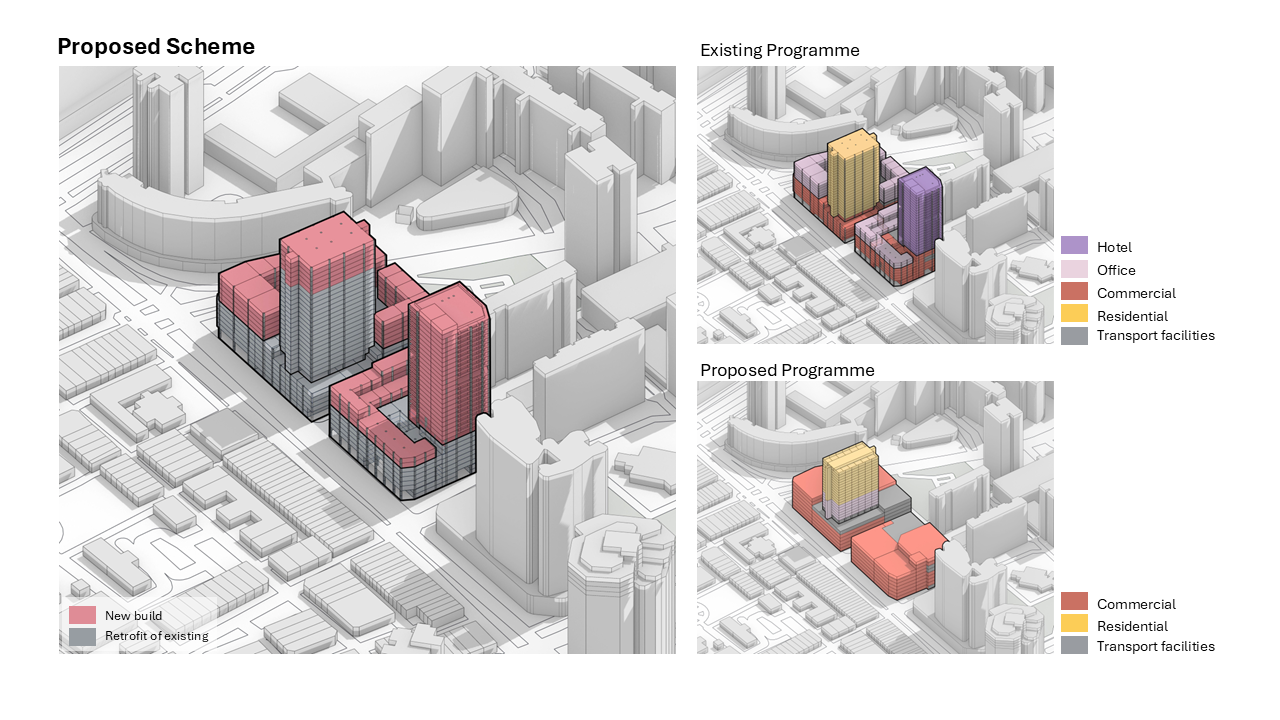
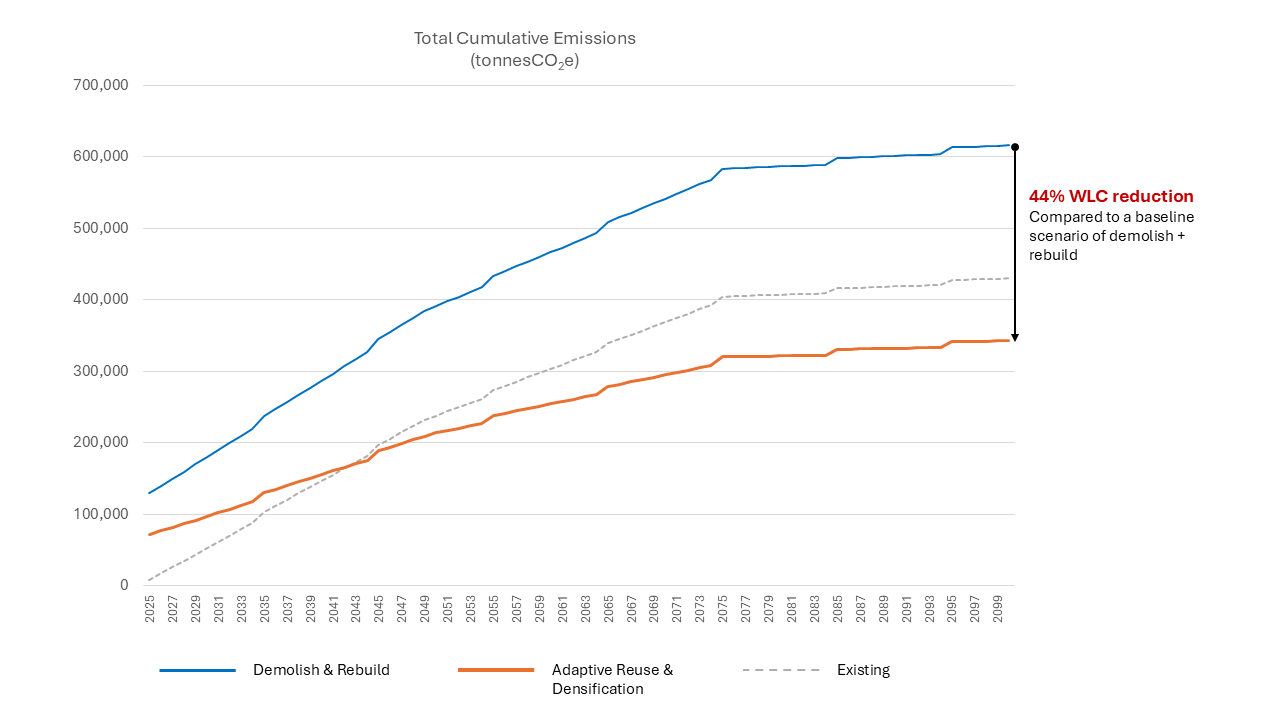
(Top) A design exploration study by NUS, showing the AR+Df capacity for the Sultan Plaza and Textile Centre located in Singapore's Central Area. The proposed design increases the overall gross plot ratio from 6.9 to 11.0—a 59% increase in gross floor area—while retaining almost all of the existing structures. (Bottom) This strategy achieves densification while reducing whole-life carbon by 44% compared to a baseline scenario of demolish and rebuild. (Department of Architecture, National University of Singapore)
Scaling the results up to the metropolitan scale, even moderate uplifts in plot ratio across mid-density residential stock could generate substantial additional housing capacity, thereby reducing the pressure to extend urbanisation into reserve sites which, in Singapore, often have ecological value. AR+Df would also reduce the risk of dispersing communities and maintain continuity of older neighbourhoods.
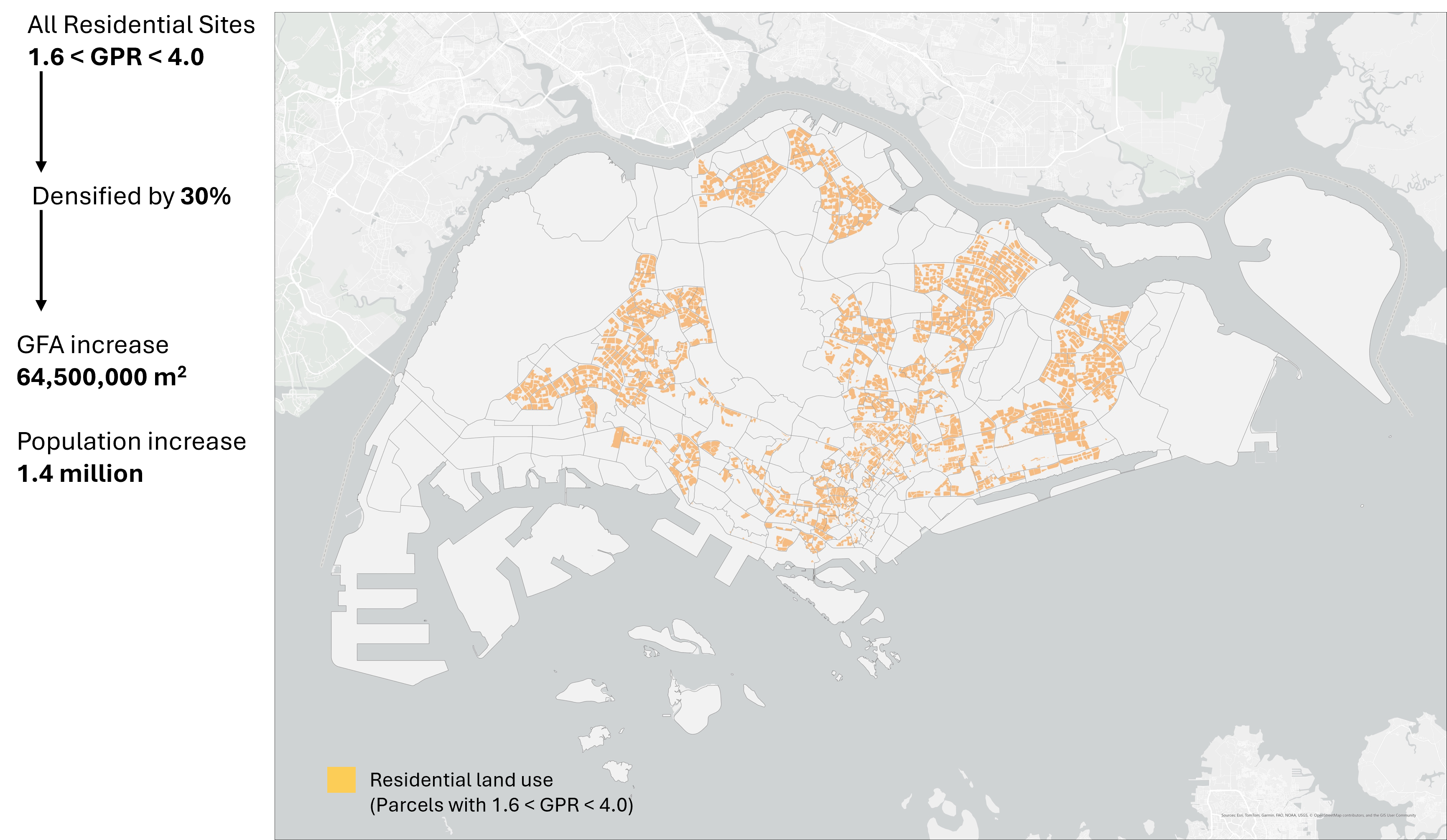
Extrapolating a moderate AR+Df approach to existing residential land parcels across Singapore yields a substantial increase in gross floor area to cater to future housing needs. (Department of Architecture, National University of Singapore)
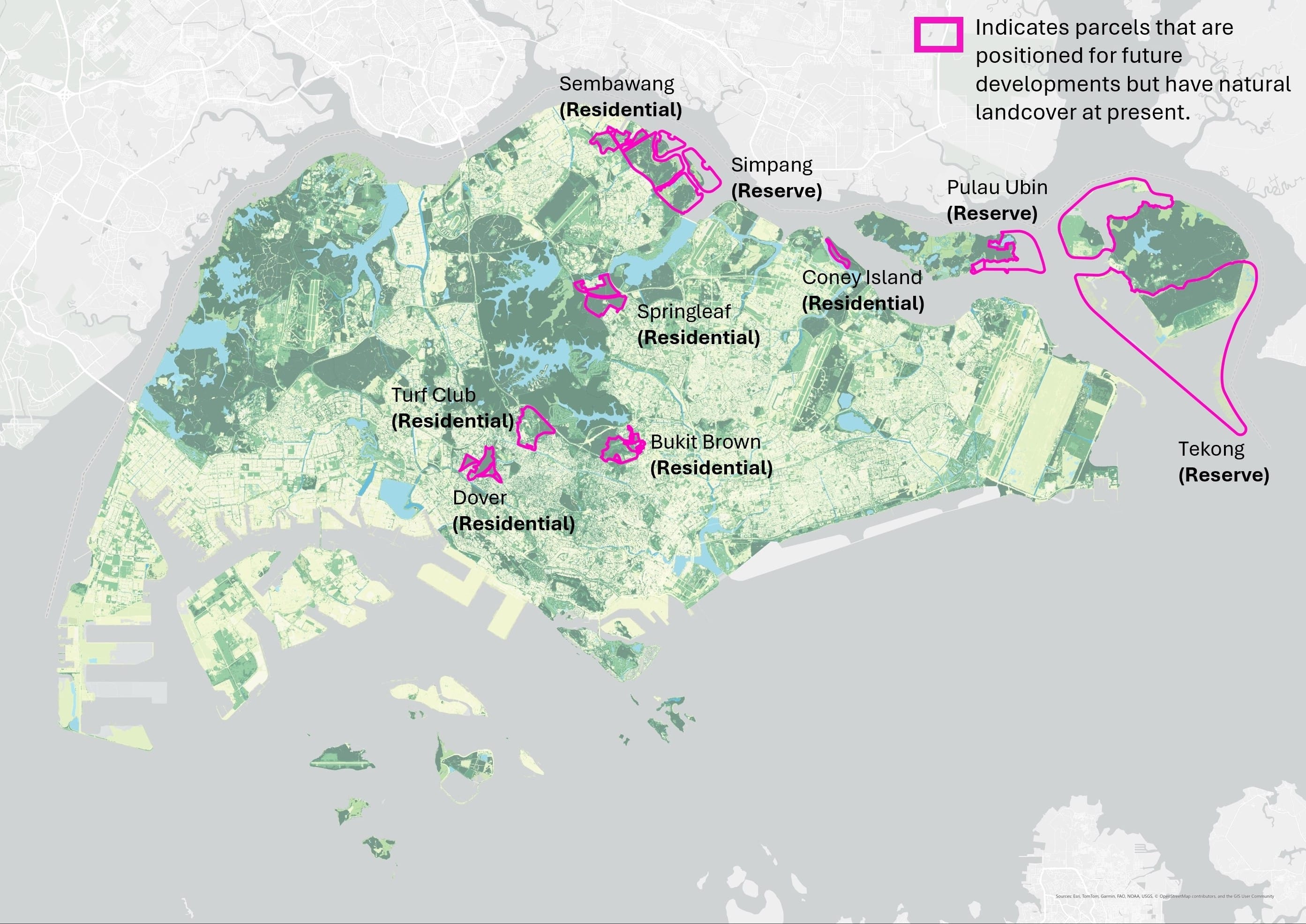
Creating capacity through AR+Df of existing residential land parcels can avert planned developments on reserved sites—many of which have important ecological value at present. (Department of Architecture, National University of Singapore)
Realising such a shift requires adjustments in governance. Mandatory whole-life carbon reporting and carbon optioneering, plus the deployment of early-stage carbon estimation tools, could align development economics with climate commitments. As part of the research at NUS, a front-end carbon tool is being developed that gives reliable lifecycle estimates from simple massing and programme data, enabling carbon to inform decisions at the feasibility stage.
The central proposition of AR+Df is to alter urban metabolism. By coupling adaptive reuse with densification, fast-growing cities can accommodate economic and population expansion while materially reducing the carbon burden associated with renewal. In an era defined by finite carbon budgets and persistent urban demand, this approach offers a pathway for growth that could be structurally, economically and climatically aligned.