
Articles
Regenerative Cities in the era of AI
7 May 2026
Research Director Elaine Tan gave the opening Keynote at the US-Singapore Research Alliance on the Resilience of Complex Cyber-Physical Infrastructure Systems (R-CPIS) in the Era of AI.
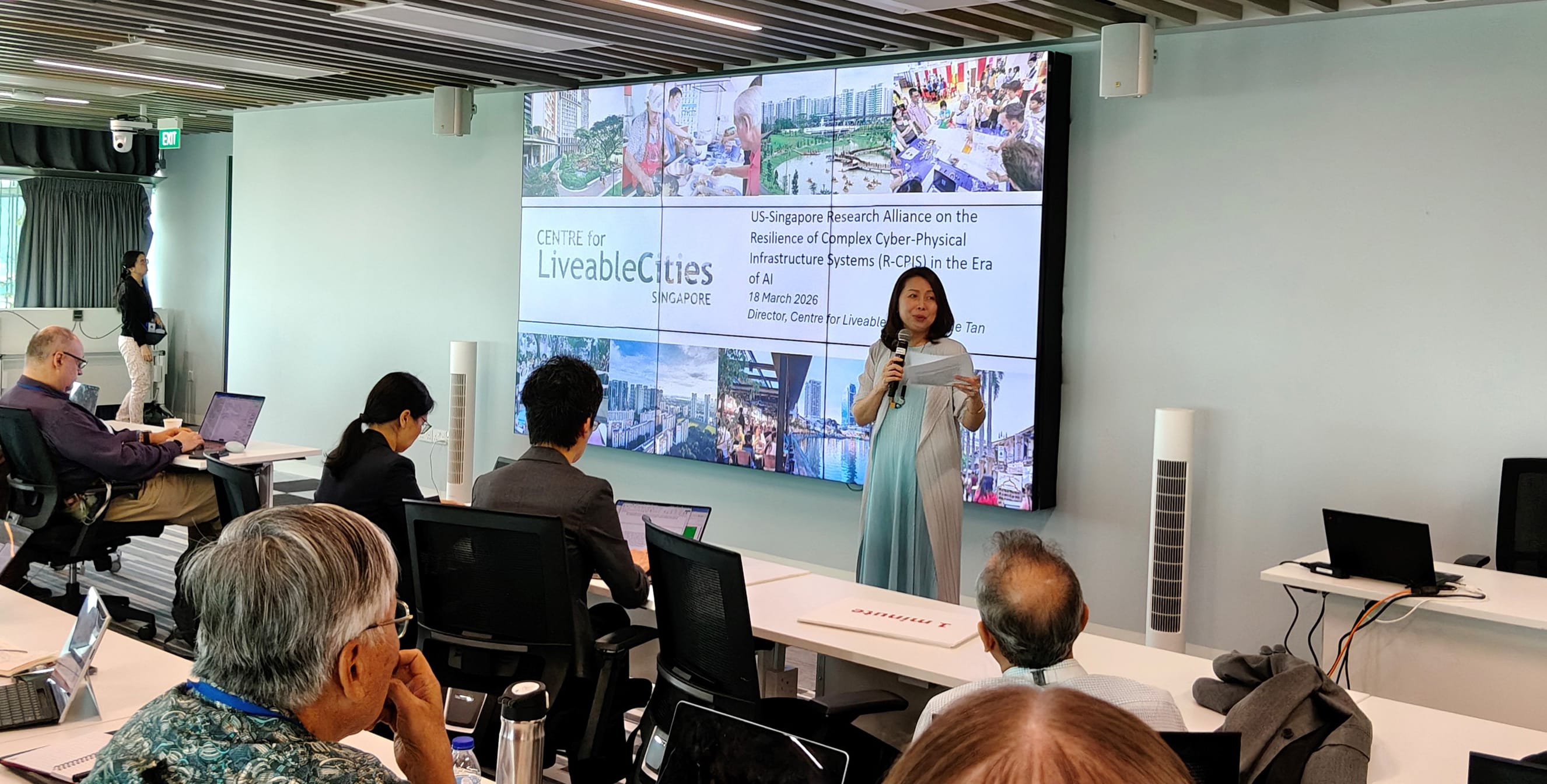
Organised by the Illinois Advanced Research Center at Singapore (Illinois ARCS), the workshop involved around 50 academics, government officers and practitioners from the U.S.A., Japan, Taiwan and Singapore. Participants discussed collaboration opportunities focusing on the resilience of complex physical infrastructure systems and generated ideas for a potential future joint funding calls between the U.S. National Science Foundation (NSF) and Singapore’s National Research Foundation (NRF).
In her speech, Elaine focused on the concept of the Regenerative City, Singapore’s efforts and CLC’s research in this area. Some key points she highlighted:
A Regenerative City can enhance a city’s liveability, sustainability and resilience by ensuring co-benefits for people, biodiversity and the environment, and not one at the expense of another.
A Regenerative City is a complex, dynamic system that leverages interdependencies, flows and loops to adapt to evolving opportunities and challenges.
Singapore has applied a long-term integrated approach to urban planning and strong governance practices to achieve liveability outcomes despite being vulnerable to the effects of climate change. For example, the Singapore Green Plan 2030 charts our efforts to transition to a low-carbon built environment and become a City in Nature.
In addition, Singapore’s Housing and Development Board has planned and built Biophilic Towns to reap multiple benefits for residents in public housing estates; while PUB, Singapore’s National Water Agency’s “Active, Beautiful, Clean Waters (ABC Waters)” programme aims to transform how Singapore manages its surface water while providing multi-purpose waterways for recreation.
Through the implementation of these efforts, Singapore is well-placed to be a front-runner for regenerative approaches by harnessing ecosystem synergies and data to leapfrog the sustainability conversation and advance our competitive advantage.
Singapore also leverages advances in technology, digitalisation, big data and AI to support our regenerative efforts. Technology and data can help to maximise capacities and optimise resources, to achieve greater impact across different urban systems.
In conclusion, Elaine encouraged participants to come together regularly to exchange knowledge and share best practices, build partnerships, and collaborate through research projects to ensure a more liveable and sustainable future.
Contributed by: Jonas Hong, Senior Assistant Director, Research