
Articles
Insights from Mexico City – People and Planet at the Heart of Urban Life
7 May 2026
Home to 26 million residents in its metro area, Mexico City is one of Latin America's most dynamic metropolises.
Yet beneath its economic vitality lies a city navigating pressing urban challenges – including social inequality and environmental pressures ranging from a sinking city centre to increasingly intense rainfall. Rather than treating these as intractable problems, Mexico City’s (Ciudad de México - CDMX) current administration has embarked on an ambitious programme of community-centred urban transformation, rooted in the belief that public infrastructure is a tool for social good.
This article showcases some of Mexico City's strategies across community spaces, environmental stewardship and urban mobility that are reshaping what it means to live well in a megacity.
Building Communities, Not Just Spaces: The UTOPIAS Programme
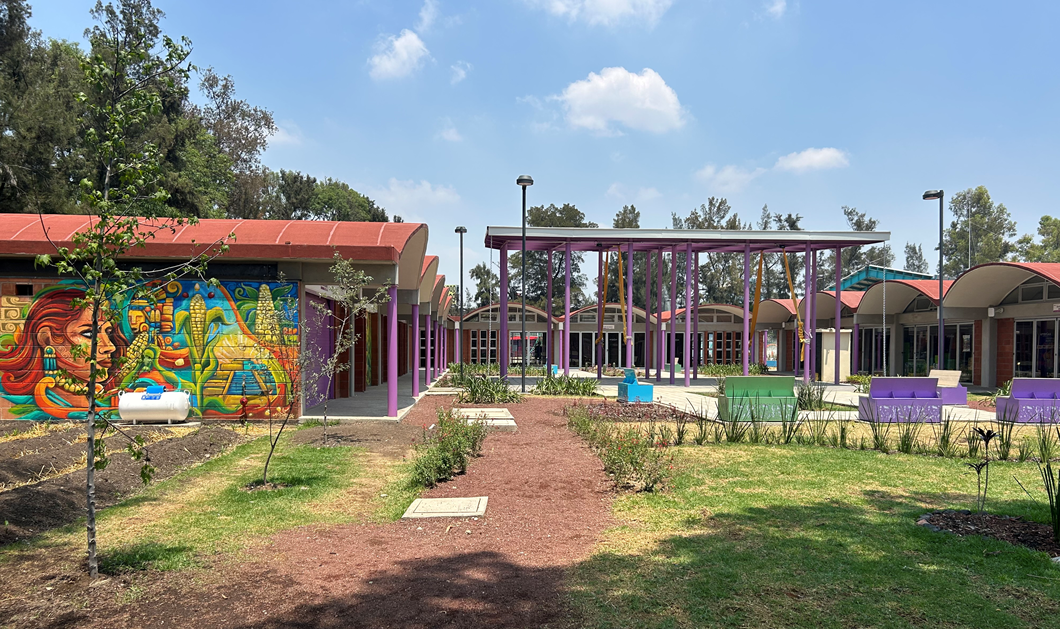
Music facilities, laundry facilities, and community spaces
Perhaps the most striking example of CDMX's approach to liveability is the UTOPIAS programme — a network of large-scale, free public facilities spread across the city's boroughs. The programme originated in the Iztapalapa borough, one of the city's most underserved boroughs, and grew from humble beginnings — soup kitchens and low-cost laundry facilities for low-income families — into a comprehensive model of holistic community care.
Each UTOPIAS facility is designed to serve the full spectrum of community needs under one roof, housing recreational areas, healthcare services, a community dining hall, laundry facilities, and dedicated spaces for women experiencing gender-based violence. Elderly residents can access day programmes with physical rehabilitation, while children benefit from remedial education and daycare. A strong emphasis on inclusivity means that services are tailored to reach the most marginalised groups in society, including those struggling with addiction and residents who have historically had little access to public care systems.
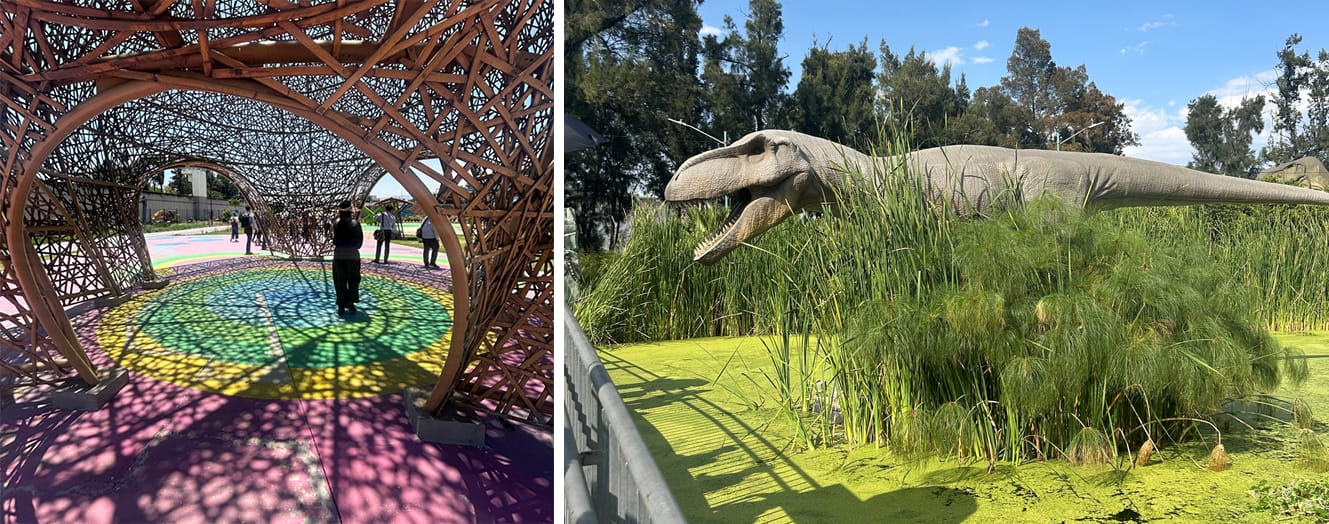
Left: Colourful play area structure for children; Right: Dinosaur park at UTOPIAS Libertad
What makes UTOPIAS distinctive is not just the breadth of services but the philosophy behind them. Many sites were built on previously abandoned or neglected land, often in areas with high crime rates, and the transformation of these spaces has had measurable knock-on effects, with reductions in violence and substance abuse reported in surrounding neighbourhoods. Each facility also has its own distinct character — UTOPIAS Libertad features a farm, butterfly area and planetarium, while others focus on theatre, sports or music — keeping the spaces fresh and drawing visitors from across borough boundaries, with some sites receiving up to 25,000 visitors in a single day. One UTOPIAS even has a dinosaur park, meant to encourage scientific curiosity amongst children.
Restoring Nature and Community: Xochimilco
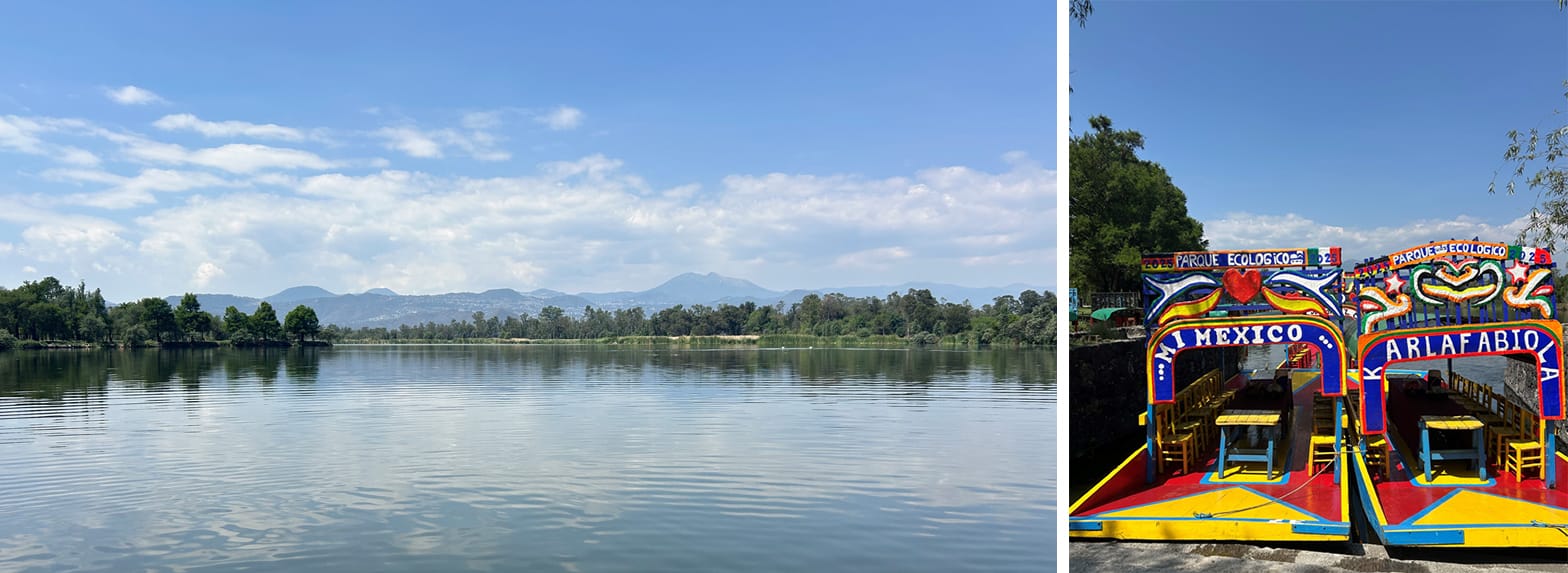
Left: View of Xochimilco; Right: Trajinera boats at Xochilmilco; these traditional, brightly painted boats are used to navigate the historic canals.
On the southern edge of the city lies Xochimilco, a UNESCO heritage area spanning 2,250 hectares. It represents one of CDMX’s most significant efforts to balance ecological restoration with community livelihoods. Once a vast network of lakes that sustained the ancient city of Tenochtitlan, Xochimilco today hosts 276 species of birds, of which 10 are critically endangered, and a rich mosaic of canals, wetlands and habitats. The city is investing in transforming the area from a recreational boating destination into a model of regenerative eco-tourism, centred on the revival of the chinampas — an ancient agricultural system in which fertile artificial islands are cultivated in the lake's mineral-rich sludge.
Working with young farmers, the city supports the growth of up to 60 varieties of crops across just two hectares using polyculture and agro-ecological methods, free from fertilisers and GMOs. Beyond food production, the chinampas serve as a living classroom, reconnecting urban residents with their food systems and pre-Hispanic heritage, while efforts to include women in farming and to help producers access broader markets ensure the model is both socially equitable and economically sustainable. The broader vision is one of circularity — ensuring that resources flow back into the territory and that the communities who steward the land are the ones who benefit from it.
Mobility and Urban Art as Instruments of Equity
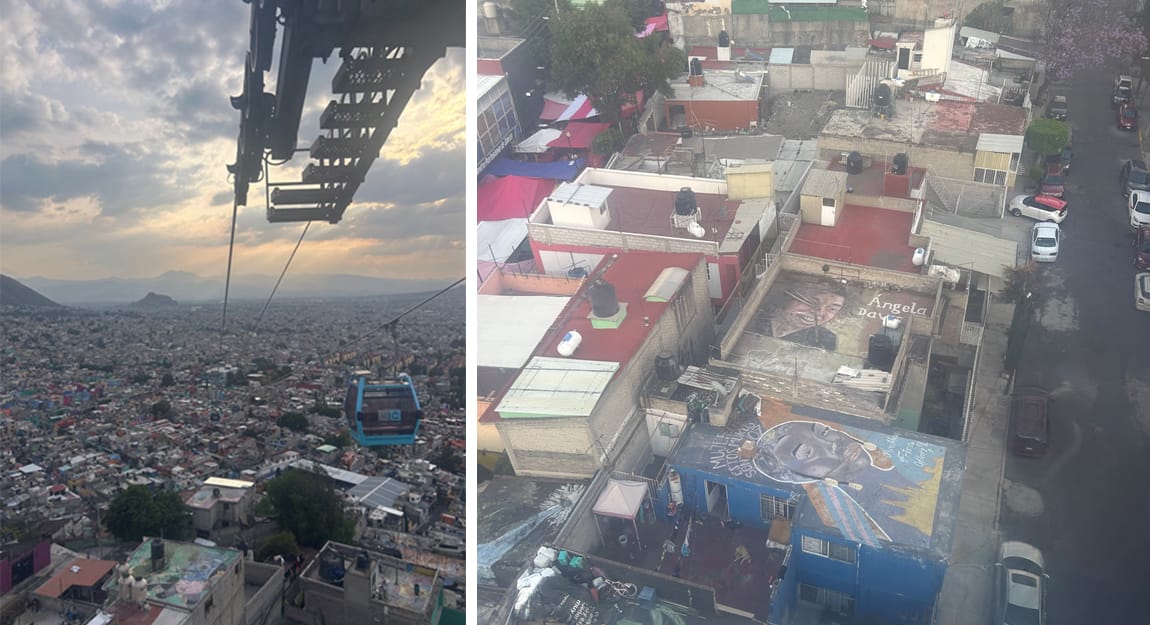
Left: Cablebús system connecting periphery areas of Mexico City; Right: Colourful rooftop murals as seen from the Cablebús
Transport infrastructure in CDMX is increasingly being designed with equity in mind. The Cablebús — a cable car system serving the hilly peripheries of the city — provides affordable connectivity at just 7 pesos (~USD$ 0.40) per ride, while the stations and surrounding buildings are covered in murals depicting daily life, geometric patterns and indigenous communities. The colours are not merely decoration but public policy in action. This integration of art and urban design reflects a broader conviction that aesthetics matter for social outcomes, changing perceptions of safety in areas previously associated with neglect and crime.
Conclusion
Mexico City's approach to liveability exemplifies the importance of working closely with communities and placing their needs at the centre of urban planning. From the UTOPIAS programme's holistic model of public care to the ecological and cultural revival of Xochimilco, and the use of art to transform everyday infrastructure, CDMX demonstrates that cities can address inequality and environmental challenges simultaneously. This foundation — rooted in the right of every resident to dignified public space, a healthy environment and a connection to their cultural roots — will be essential as it continues to navigate the pressures of growth and urban change.
Contributed by Cheryl Lim, Assistant Director, Research