
Articles
Building Thriving Urban Futures – CLC at the Resilient Cities Forum 2025
26 January 2026
CLC represented Singapore at the Resilient Cities Forum in London (7-9 Dec 2025), organised by Resilient Cities Network and The Conduit, which examined the intersection between enhanced community resilience and data-driven urban governance.
Attended by about 300 city leaders, investors, urban practitioners, and Chief Resilience Officers from the Resilient Cities Network’s (RCN) member cities, the Resilient Cities Forum (RCF) sought to accelerate proven, scalable solutions and financial mechanisms to ensure cities thrive amidst urban and climate challenges. RCN is also a strategic partner of CLC’s World Cities Summit.
RCF Panel on place-based approaches
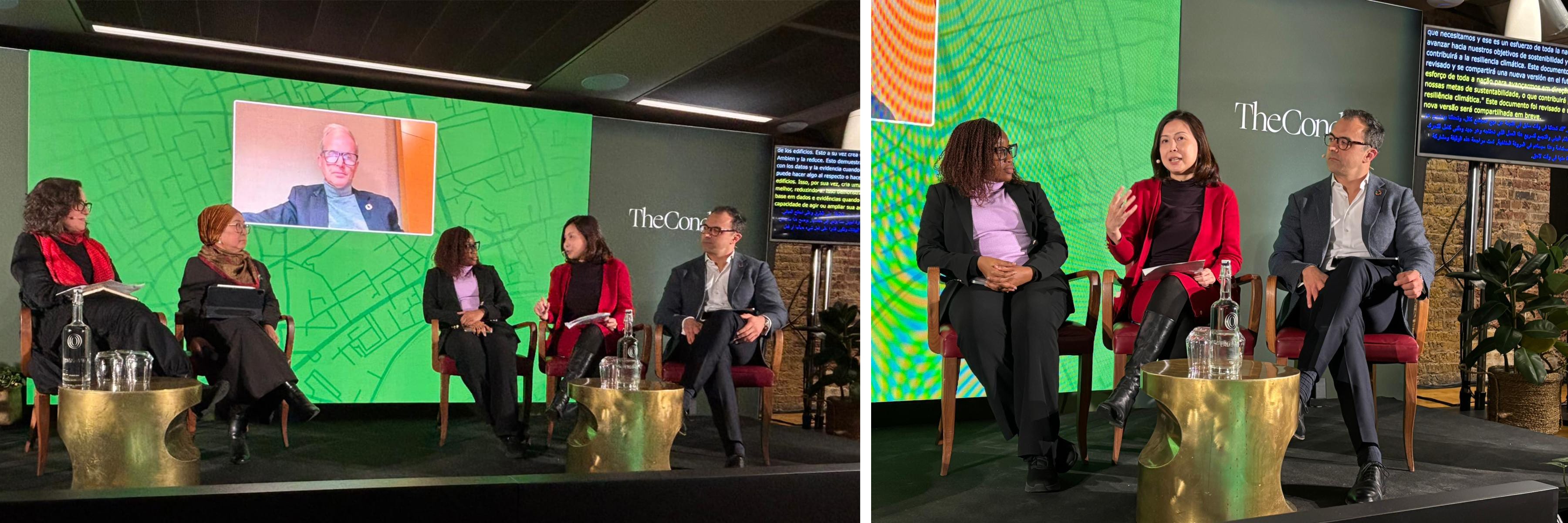
(L to R) Dr. Jeanette Ickovics, Dr. Jemilah Mahmood, Mr. Erik Berglof (on screen), Dr. Folayinka Dania, D/CLC Elaine Tan, and Mr. Glyn Richards. Source: Alysia Wee
At the Forum, CLC Director, Research, Elaine Tan spoke on a panel titled From Data to Action: Solutions to Address Climate, Health and Equity. Fellow panellists were Jemilah Mahmood (Executive Director, Sunway Centre for Planetary Health), Dr Folayinka Dania (Chief Resilience Officer, Lagos), Erik Berglof (Chief Economist, Asian Infrastructure Investment Bank), and Glyn Richards (Director Sustainability, Bupa). Moderated by Professor Jeannette Ickovics (Yale School of Public Health), the panel focused on the intersections between urban heat and health and highlighted how place-based approaches can protect communities from climate impacts.
Elaine spoke about how Singapore leverages data-informed urban planning and design, incentive schemes, and innovation to tackle extreme heat, sharing examples such as URA’s LUSH programme and plans to implement cool paint in all existing HDB estates by 2030.
On how climate change may lead to cascading impacts on critical urban infrastructure, Dr Folayinka Dania shared on the less-understood health impacts among vulnerable populations. For instance, climate projections in a BAU scenario indicate that 5% of Lagos would be inundated with water by 2050. This would result in the loss of about 400 hospitals, leaving more than 2 million people without access to healthcare, amongst other impacts.
Dr. Jemilah Mahmood brought attention to the issue that increasing heat may have implications not only to physical health and the inclination to exercise outdoors as a routine, but also on mental and maternal health.
Key Takeaways from RCF:
It is useful to identify the foremost problem or concern preventing the city from achieving resilience when developing an urban resilience strategy.
It is essential to invest more in social infrastructure and building social capital. In times of crisis, communities are more likely to approach organisations that have established presence on the ground and are already trusted within the community.
With climate impacts expected to worsen over time, the finance and insurance sectors will have to adjust current operating models, thus presenting an opportunity for policy intervention.
Cities and local governments must work to overcome institutional siloes by fostering data and information sharing. Platforms that integrate data across various domains could be useful in helping city leaders and urban practitioners consider how urban interventions may generate co-benefits in multiple areas.
Workshop on Role of Public Spaces in Strengthening Urban Resilience
In addition to the panel at RCF, the CLC delegation also participated in a workshop on the role of public spaces in strengthening urban resilience. The workshop was organised by Westminster City Council and The Crown Estate, and focused on London’s Regent Street, Haymarket and the Piccadilly area as a live case study.
Participants explored how cities can reimagine their public realm to build resilience, address climate challenges and support positive health outcomes, while preserving built and cultural heritage. Drawing on the participants’ global perspectives, strategies around the following were discussed:
Integrating a pedestrian-friendly design, incorporating nature and green spaces, and preserving cultural and built heritage.
Creating service access points and drop-off nodes at the corners of pedestrianised areas, as well as the importance of selecting climate-appropriate plant species that can thrive in urban habitats.
Site visit to Thames Tideway Tunnel and Thames Barrier
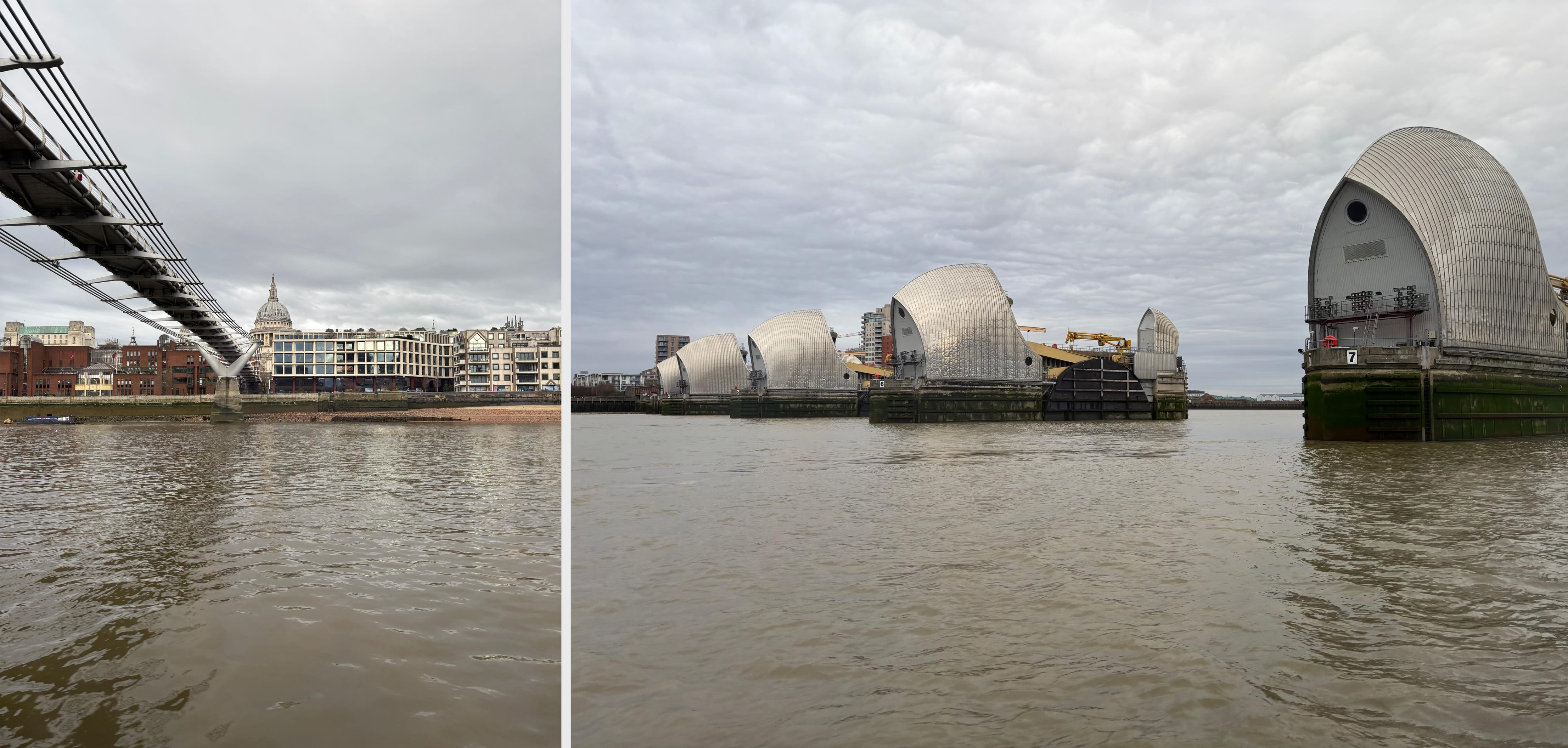
View of the Thames Barrier, which protects about 125 km2 of central London, including historically significant buildings such as St Paul’s Cathedral (left picture) and the Tower of London. Source: Alysia Wee
The CLC delegation went on a site visit along the River Thames to learn more about the Thames Tideway Tunnel and Thames Barrier.
At 25km in length, the Thames Tideway Tunnel runs through 12 different London boroughs and connects existing sewers across 21 separate sites. It is an upgrade to London’s existing sewer system, which was originally built to serve a population less than half its current size of approximately nine million. The tunnel reduces untreated sewer discharge into the River Thames by 95% and will enable London’s 150-year-old sewerage system to continue serving the city for at least the next 120 years.
The Tideway Tunnel has resulted in an overall improvement in the Thames’ water quality and a reduction in the number of sewage spills a year (from more than 50 to about five incidents). A cleaner Thames is also better able to support aquatic wildlife, including more than 100 fish species. The project has also encouraged Londoners to reconnect with the river as a public amenity, resulting in an increase in water sports and activities such as kayaking.
The Thames Barrier is another integral part of London’s resilience infrastructure. The barrier protects about 125 km2 of central London from flooding, including about 60 London Underground stations that are situated within the Thames floodplain. The barrier was commissioned in response to a North Sea storm surge in 1953 which killed more than 2000 people across Europe, including more than 300 people in the UK. Completed in 1982, it was designed to mitigate the risk of storm surges coinciding with high tides, which had historically caused severe flooding of the Thames.
In closing, the Resilient Cities Forum, Westminster City Council’s workshop and the site visit provided valuable platforms that facilitate knowledge exchange and mutual learning on how cities can strengthen urban resilience in the face of climate change. CLC looks forward to more such conversations on the global stage and to welcoming city leaders from around the world to the World Cities Summit 2026 to further discussions.
Contributed by Elaine Tan, Director, Research