
Issue 29: Sustainable Mobility
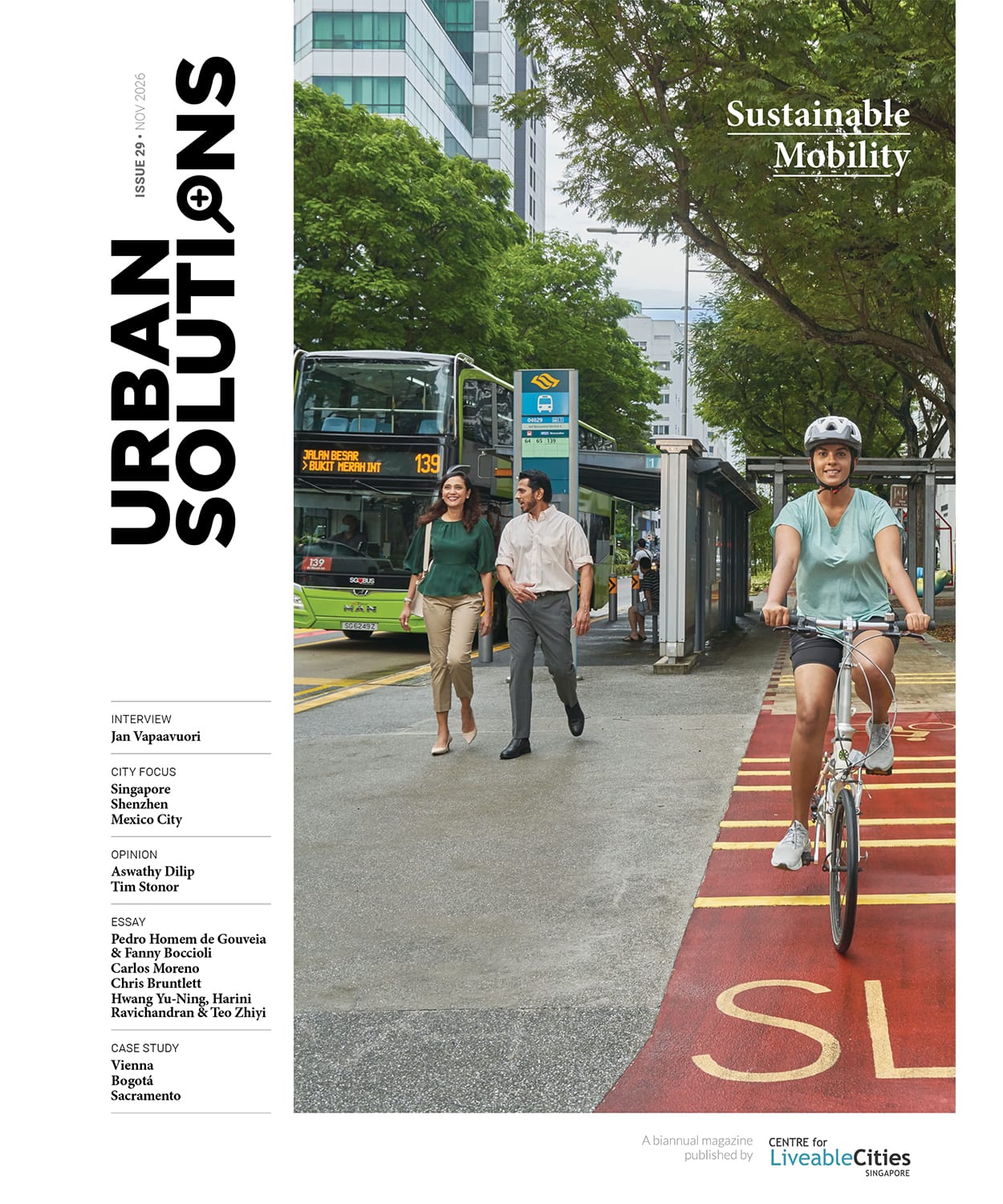
Launched at COP31, the latest issue of Urban Solutions explores how cities can make mobility more sustainable, inclusive and liveable. Through perspectives from city leaders, practitioners and researchers, it examines how transport choices shape urban life—from the design of streets and transport networks to their wider effects on health, the environment and communities.
Last updated on 18 November 2026
In this Issue
All articles are in pdf format each ranging 1-2 MB in file size.
Interview
HELSINKI PROVES A SMOOTH, SAFE AND LOW-EMISSION TRANSPORT SYSTEM IS POSSIBLE [PDF, 383.55 KB] (opens in new tab)
JAN VAPAAVUORI
City Focus
THE NORTH-SOUTH CORRIDOR: REIMAGINING JOURNEYS OF TOMORROW [PDF, 1.53 MB] (opens in new tab)
SINGAPORE
Opinion
THE FUTURE OF INDIA'S STREETS: FROM NATIONAL CHALLENGE TO STATE-LED TRANSFORMATIONS [PDF, 289.18 KB] (opens in new tab)
ASWATHY DILIP
Essay
HOW EUROPEAN CITIES ARE LEARNING TO GOVERN SHARED MICROMOBILITY [PDF, 327.74 KB] (opens in new tab)
PEDRO HOMEM DE GOUVEIA & FANNY BOCCIOLI
SUSTAINABLE PROXIMITY: RESTORING TIME, TRUST AND QUALITY OF LIFE [PDF, 441.70 KB] (opens in new tab)
CARLOS MORENO
BRIDGING BICYCLE KINGDOMS: DUTCH-SINO COLLABORATION IN CHINA'S CYCLING RESURGENCE [PDF, 407.87 KB] (opens in new tab)
CHRIS BRUNTLETT
BEYOND MOVEMENT: RETHINKING MOBILITY THROUGH A CROSS-DOMAIN LENS [PDF, 344.39 KB] (opens in new tab)
HWANG YU-NING, HARINI RAVICHANDRAN & TEO ZHIYI
Case Study
BEYOND LEADERSHIP: VIENNA'S APPROACH TO LASTING MOBILITY REFORM [PDF, 2.02 MB] (opens in new tab)
VIENNA | SUSTAINING MOBILITY REFORM
LEARNING TO CARE: THE LEGACY OF BOGOTÁ'S DISTRICT CARE SYSTEM [PDF, 1.97 MB] (opens in new tab)
BOGOTÁ | CARE-CENTRED MOBILITY
HOW SACRAMENTO VALLEY STATION REALISES ITS AMBITION FOR A REGENERATIVE URBAN DISTRICT [PDF, 1.95 MB] (opens in new tab)
SACRAMENTO | REGENERATIVE INFRASTRUCTURE
Download PDF [PDF, 9.49 MB] (opens in new tab)
Message from the Executive Director
Advancing Sustainable Mobility for More Liveable Cities
Mobility is fundamental to how we experience our cities. It determines how easily we reach jobs, schools, services and one another. But the way we move also shapes the streets and neighbourhoods around us, the air we breathe, our health and well-being, and whether our cities feel accessible, inclusive and enjoyable to live in. As cities seek to reduce emissions, adapt to changing climatic conditions and respond to evolving urban needs, rethinking how we move offers opportunities that extend far beyond transport. This issue of Urban Solutions explores how sustainable mobility can contribute to more resilient and liveable cities, bringing together perspectives from everyday journeys to questions of governance, infrastructure and urban transformation.
Different Routes to Sustainable Mobility
Cities are pursuing different paths to sustainable mobility. Singapore’s North-South Corridor demonstrates how transport infrastructure can be planned as part of a wider urban system, integrating public transport, walking and cycling while reconnecting neighbourhoods and reclaiming more space for people. India’s experience demonstrates how experiments in walking and cycling can build momentum for change, while Shenzhen’s experience offers lessons in advancing sustainable mobility at scale. Sacramento Valley Station illustrates how a major transport investment can catalyse wider urban regeneration, integrating mobility with housing, public space, energy and water. The mobility landscape is evolving too. POLIS examines how European cities are adapting governance approaches to shared micromobility, while Helsinki’s former Mayor Jan Vapaavuori argues for a systemic approach that brings together public transport, active mobility, technology and emerging services.
Measuring What Matters
The possibilities extend beyond mobility itself. CLC’s research explores how a cross-domain lens can reveal the wider impacts of mobility interventions, helping decision-makers make more informed and integrated choices. Tim Stonor, meanwhile, shows how spatial analysis can help cities better understand the underlying conditions that enable walking and cycling. Together, they show how better evidence and broader measures of success can inform planning decisions and help cities understand how changes unfold over time. Sustainable mobility must respond to the distinct needs and conditions of each city, from climate and geography to urban form, institutions and culture. There is no single blueprint. Cities must chart their own paths, recognising opportunities for wider benefits while navigating competing priorities and trade-offs. Ultimately, sustainable mobility is not simply about moving people more efficiently. I hope the perspectives shared in this issue encourage us to think more broadly about how the choices we make can accelerate the transition to sustainable mobility at scale and help create cities that are more connected, inclusive, resilient and liveable.
Hwang Yu-Ning
Executive Director
Centre for Liveable Cities