
Issue 28: ACT Now!
The 28th edition published alongside the milestone 10th edition of the World Cities Summit 2026 explores how cities can ACT Now—Accelerate, Collaborate and Transform—to actively shape a more liveable future for all. The articles feature best practices and thought leadership from around the world, showcasing how cities are addressing urban challenges and unlocking new opportunities.
Last updated on 12 June 2026
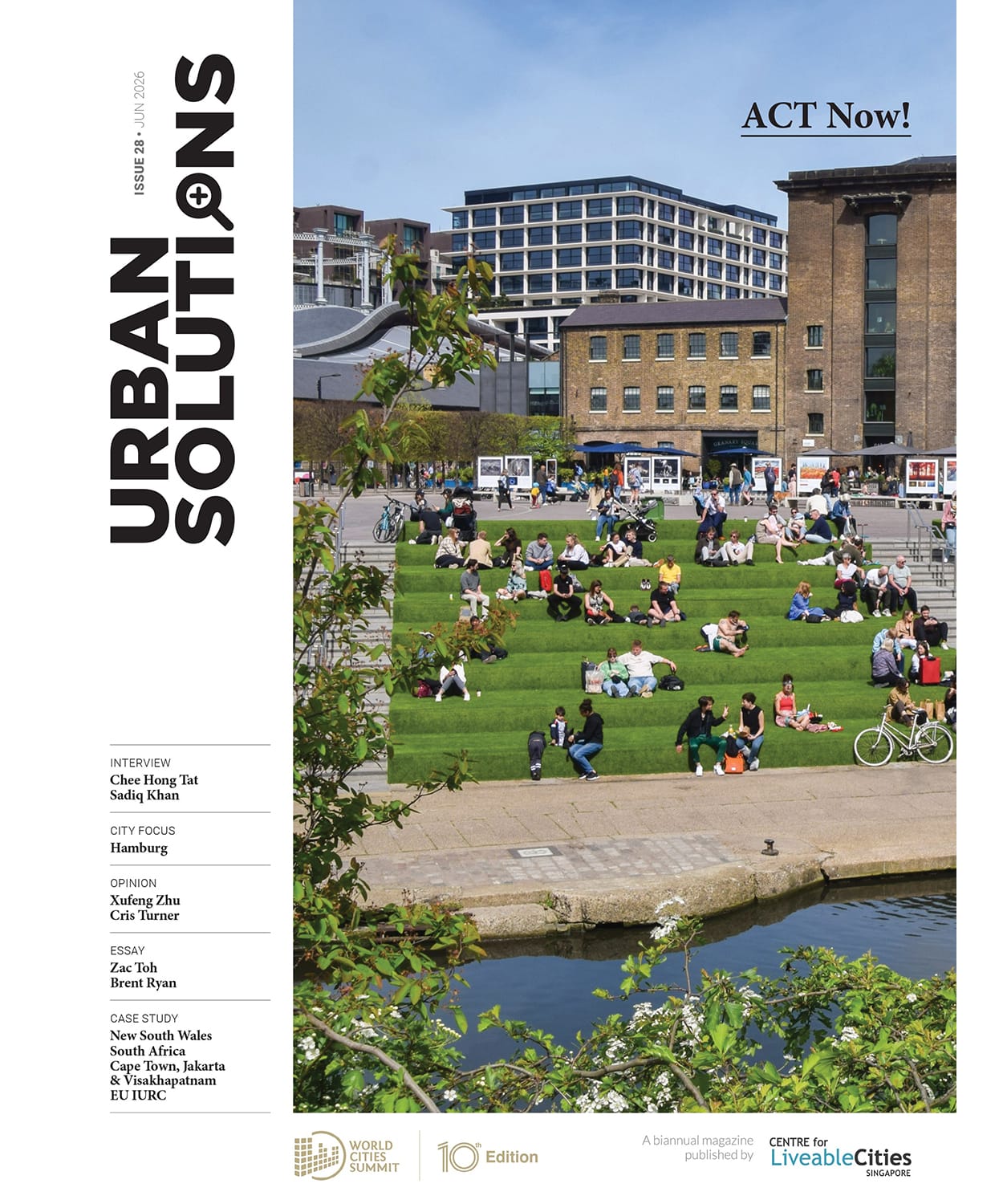
In this Issue
All articles are in pdf format each ranging 1-2 MB in file size.
Interview
PLANNING FOR TOMORROW: SINGAPORE’S BLUEPRINT TO STAY LIVEABLE, AGILE AND PRO-ENTERPRISE [PDF, 556 KB] (opens in new tab)
CHEE HONG TAT
BUILDING A FAIRER, GREENER, SAFER AND MORE PROSPEROUS LONDON [PDF, 628 KB] (opens in new tab)
SADIQ KHAN
City Focus
WATERFRONT DEVELOPMENT IN THE PORT CITY [PDF, 1.90 MB] (opens in new tab)
HAMBURG
Opinion
AGILE CITY GOVERNANCE IN THE DIGITAL AGE [PDF, 270KB] (opens in new tab)
XUFENG ZHU
Essay
WEAVING GREEN THREADS: BUILDING RESILIENT CITIES FROM THE GROUND UP [PDF, 883 KB] (opens in new tab)
ZAC TOH
PLANNING AND DESIGNING THE CITY FOR ALL AGES: EVOLVING URBAN PLANNING FOR DEMOGRAPHIC CHANGE, HEALTH AND WELL-BEING [PDF, 867 KB] (opens in new tab)
BRENT D. RYAN
Illustration
HOW PLAYFUL CITIES STRENGTHEN HEALTH, EQUITY AND URBAN RESILIENCE [PDF, 2.00 MB] (opens in new tab)
SARA CANDIRACCI
THROUGH THE YEARS: WORLD CITIES SUMMIT—THE 10TH EDITION SPECIAL [PDF, 789 KB] (opens in new tab)
Case Study
POWERING UP THE NEON GRID TO REVITALISE NEW SOUTH WALES, AUSTRALIA [PDF, 2.32 MB] (opens in new tab)
NEW SOUTH WALES | URBAN TRANSFORMATION
SOUTH AFRICA’S NATIONAL URBAN FORUM: POLICY DIALOGUES ON SUSTAINABLE URBAN DEVELOPMENT [PDF, 1.34 MB] (opens in new tab)
SOUTH AFRICA | DISCUSSION PLATFORMS
THE INTERNATIONAL FINANCE CORPORATION’S APEX PLATFORM: MOBILISING SUSTAINABLE INVESTMENT IN CITIES [PDF, 1.20 MB] (opens in new tab)
GLOBAL | CLIMATE FINANCING
INTERNATIONAL URBAN AND REGIONAL COOPERATION ASIA AND AUSTRALASIA (PHASE 1): CITY-TO-CITY PARTNERSHIPS [PDF, 1.79 MB] (opens in new tab)
GLOBAL | INTERNATIONAL PARTNERSHIPS
Download PDF [PDF, 26.1 MB] (opens in new tab)
Message from the Executive Director
Why Cities Need to ACT Now
In the face of changing demographics, economic disruption, technological advances and the growing impacts of climate change, cities need to take bold transformational steps.
Published alongside the milestone 10th edition of the World Cities Summit, this issue of Urban Solutions explores how cities can ACT now— accelerate, collaborate and transform—to actively shape a more liveable future for all. Across the articles, three key themes emerge.
People-centred policy and design create shared benefits.
Minister for National Development Chee Hong Tat highlights how Singapore's adaptive urban planning and housing policies are responding to changing needs and aspirations, and the ways the city is supporting the built environment sector to advance new solutions. Mayor of London Sadiq Khan illustrates how innovative strategies led to improved liveability outcomes, earning the city the title of the Lee Kuan Yew World City Prize Laureate 2026.
Health and well-being are increasingly central to urban design as cities accelerate their efforts to create healthier environments. Dr Sara Candiracci explains that cities can integrate play into everyday spaces to support communities, while Professor Brent Ryan explores designing cities for all ages that meet the needs of current and future residents.
Strategic innovation unlocks urban potential.
Hamburg's distinctive approaches to its waterfront developments exemplify how cities can reimagine urban spaces as catalysts for sustainable growth. New South Wales' comprehensive 24-Hour Economy Strategy demonstrates that tailored policies can revitalise the after-dark experience, creating dynamic urban environments that unlock economic vitality.
Cities are also transforming through the power of technology to test and scale urban solutions. Professor Xufeng Zhu outlines the use of artificial intelligence (AI) in Chinese cities to enhance urban governance and deliver public services effectively. But as Cris Turner points out, it is crucial to balance the trade-offs that arise with the use of AI in our urban interventions.
Collaborative networks amplify global impacts.
Cities recognise that collaboration is essential to address common issues. The International Urban and Regional Cooperation Asia and Australasia programme reinforces the value of crossborder exchanges. Similarly, the International Finance Corporation's APEX platform shows how partnerships and evidence-based solutions can help translate ambitious climate plans into actionable investment strategies.
Convening local stakeholders through platforms such as the National Urban Forum coordinated by the South African Local Government Association is equally important to address common goals. At the grassroots level, Zac Toh shares how ground-up initiatives can play a vital role in fostering stronger community ties and social cohesion.
I hope the insights shared here will illuminate the way ahead for us to leverage the power of cities to make transformational change to improve urban life.
Hugh Lim
Executive Director
Centre for Liveable Cities